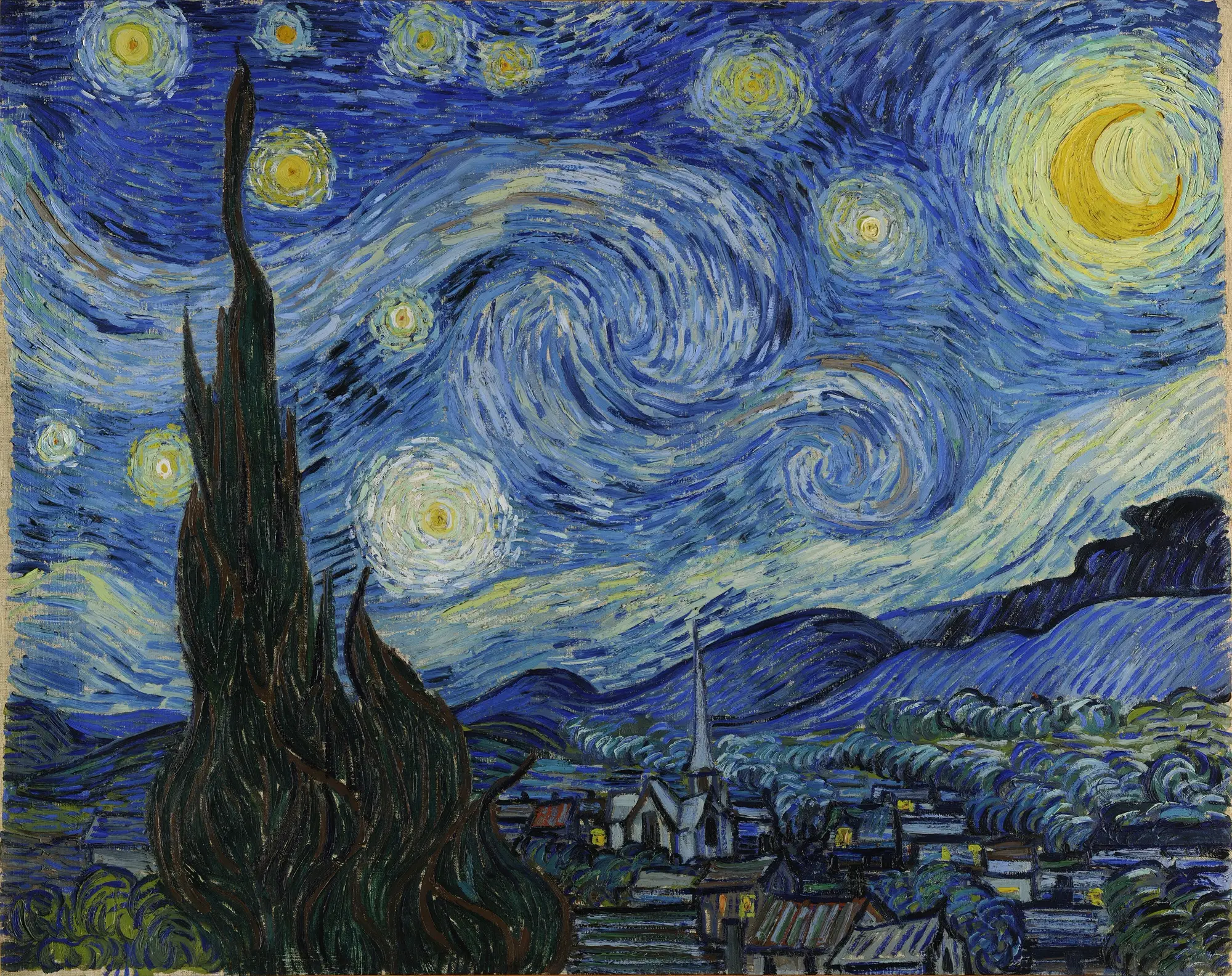
Starry Night
The sight of the stars always sets me dreaming, as simply as the black dots that stand for towns and villages on a map.
* In the original: Mais toujours la vue des étoiles me fait rêver aussi simplement que me donnent à rêver les points noirs représentant sur la carte géographique villes & villages.
How to learn to read the sky. All you need is your eyes, some darkness and a little patience.
Van Gogh looked at the stars as if they were a map. He was more right than he knew: the night sky really can be read. It has main roads, landmarks and places where a beginner reliably gets lost.
This page walks you through one night, from dusk to dawn. You don’t need a telescope. You won’t find a horoscope here, but you will find out which dot is a star, which is a planet and which is on its way to London.
Dusk
Darkness doesn’t arrive all at once. It comes in three acts
The Sun has set, but it isn’t night yet. Astronomers split twilight into three parts according to how far below the horizon the Sun is. Meanwhile, your eyes are rebuilding themselves too.
Civil twilight: the first dots
The Sun is no more than 6° below the horizon. You can usually still see outdoors without a lamp and make out the landscape and the horizon. The brightest planets and stars appear. So if a single bold dot is shining in the west, it tends to be a planet.
Nautical twilight: the horizon holds on
The Sun sinks between 6° and 12° below the horizon. The name comes from sailors: the line of the horizon is still visible and there are already enough stars to take a position from. On the ground, things are down to outlines.
Astronomical twilight: almost night
The Sun is 12° to 18° below the horizon. To most people the sky looks fully dark, yet faint nebulae and galaxies are still drowned in leftover light. True night only begins below 18°. Around the summer solstice the Sun never gets that deep at latitude 49° north, so June nights in our part of Europe never go completely dark.
Your eyes need half an hour
Your pupil widens quickly, but that is only a small part of the job. The retina does most of it. The cones, which see colour, adjust to the dark in about 10 minutes. The rods, which see in dim light, need 30 to 45 minutes. Their visual pigment, rhodopsin, bleaches instantly in light and then rebuilds slowly.
Why stargazers carry red torches
Rods are most sensitive to blue-green light and barely respond to red. So with a red torch you can read your chart and keep your night vision. One glance at a white phone screen and you start waiting all over again. Dim the phone, or leave it in your pocket.
Darkness
How many stars do you have left?
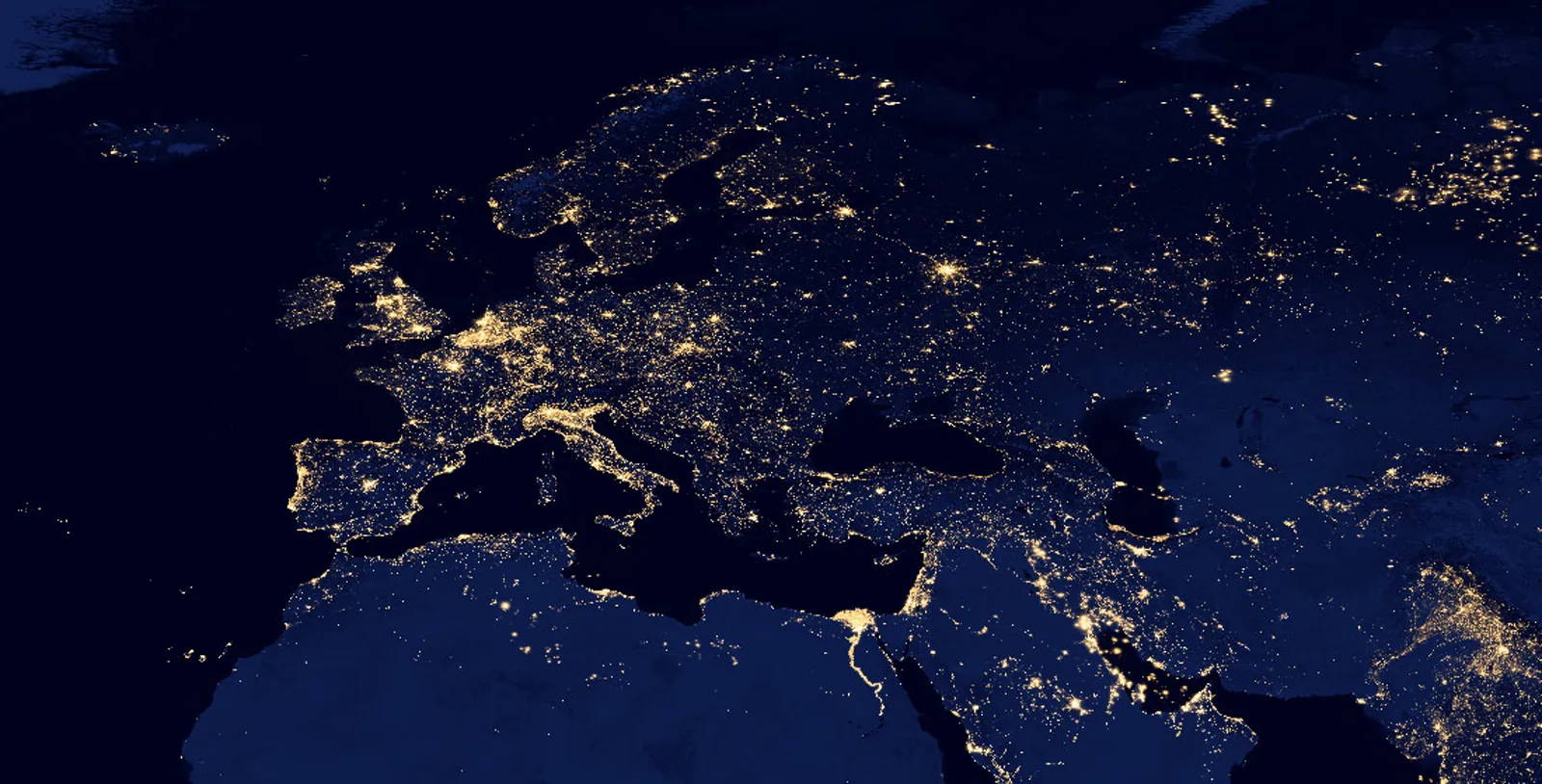
Light pollution is the human-made alteration of natural light levels at night. In the sky you see it as a glow over inhabited places: lamplight scatters in the air and the fainter stars vanish into it. The stars are still there. We are just shouting over them.
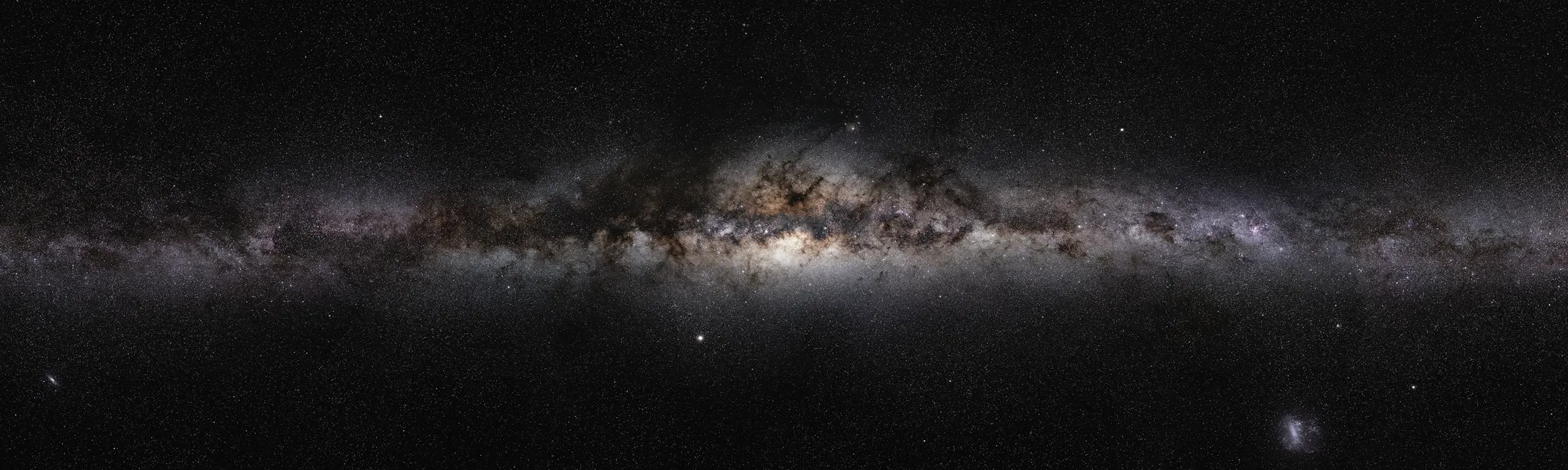
The Bortle scale in three steps
In 2001 the American amateur astronomer John Bortle published a nine-class scale in Sky & Telescope magazine: class 1 is the darkest sky, class 9 an inner city. Here it is boiled down to three stops. The star counts are rough and apply to a single moment and the half of the sky above you.
Where are you looking from
City centre Bortle 8–9
- Naked-eye stars
- a few dozen
- Milky Way
- No Milky Way
Only the brightest stars and the planets remain. With a limit around magnitude 2 that means about 35 stars at once. You can still piece together the Big Dipper, but not much else.
Town edge and village Bortle 4–5
- Naked-eye stars
- hundreds
- Milky Way
- Milky Way visible high overhead, washed out near the horizon
In suburbs with a limit around magnitude 4 you see roughly 450 stars at once. The further you get from the lamps, the more appear and the constellations start to make sense. A dome of light still hangs over the nearest town, though.
Dark-sky park Bortle 1–3
- Naked-eye stars
- around 4,500
- Milky Way
- A structured Milky Way with dark dust lanes
About 9,000 stars can be counted with the naked eye across the whole sky, and half of them are above the horizon at any time. It sounds modest, but under a truly dark sky it feels like millions. Oddly, constellations get harder to find because they are lost in the crowd.
- 9.6% a year
That is how fast the night sky brightened on average between 2011 and 2022. The figure comes from 51,351 observations in which volunteers around the world compared how many stars they could see with the naked eye. At that rate sky brightness doubles in about eight years. Satellites had measured much slower growth because they miss part of the light from modern lamps.
Kyba et al., Science, 2023 - 60% of Europeans
According to a 2016 atlas, that many people in Europe cannot see the Milky Way from where they live. More than 99% of Europe’s population lives under light-polluted skies.
Falchi et al., Science Advances, 2016
The first five
Five patterns that will stop you getting lost
The International Astronomical Union recognises 88 constellations. Five patterns are enough to begin with. Each one leads on to others, which is known as star-hopping. All directions here are for our latitude, roughly 49° north.
The Big Dipper
Ursa Major
When. All year round; from our latitude it never sets. On spring and summer evenings it rides high, in autumn and winter it sinks low over the northern horizon.
- Step 1 / 4
Face north and look for seven bright stars: four make the bowl, three the handle.
- Step 2 / 4
From the bowl to the tip of the handle they are Dubhe, Merak, Phecda, Megrez, Alioth, Mizar and Alkaid.
- Step 3 / 4
Look at Mizar, the middle star of the handle. Fainter Alcor sits right beside it. The pair was once used as an eyesight test.
- Step 4 / 4
Remember the two stars at the front of the bowl, Merak and Dubhe. In a moment they will show you north.
- What it is
- The Big Dipper is not a constellation, just the brightest part of Ursa Major, the Great Bear. Five of its seven stars travel through space together, about 80 light-years away. Dubhe (124) and Alkaid (104 light-years) are not part of the group.
- Common mistake
- Mixing it up with the Little Dipper. That one is smaller, flipped, and its middle stars are so faint you won’t see them from a town. The tiny dipper shape of the Pleiades in the winter sky fools people the same way.
Polaris and Cassiopeia
Ursa Minor, Cassiopeia
When. All year. Polaris stays in the same place; Cassiopeia circles around it and never sets.
- Step 1 / 4
Go back to the front of the Big Dipper’s bowl. Join Merak to Dubhe and keep going in that direction.
- Step 2 / 4
After about five times the gap between them you reach a lonely, moderately bright star. That is Polaris.
- Step 3 / 4
Drop your gaze straight down from it to the horizon. That is north. The height of Polaris above the horizon equals your latitude.
- Step 4 / 4
Now run a line from Alkaid, the last star of the handle, through Polaris and beyond. On the far side you find five stars in a W or M shape: Cassiopeia.
- What it is
- Polaris is a yellow supergiant and a pulsating Cepheid variable, in fact a triple star roughly 450 light-years away. It lies less than one degree from the north celestial pole, which is why it barely moves.
- Common mistake
- Polaris is not the brightest star in the sky. It ranks around 47th. It is special for where it is, not for how bright it shines.
Orion
Orion
When. Winter. Best seen in the evening from January to April, above the southern horizon.
- Step 1 / 5
Look for three equally bright stars in a tight row. That is Orion’s Belt: Alnitak, Alnilam and Mintaka.
- Step 2 / 5
Above the Belt to the left shines orange-red Betelgeuse, below it to the right blue-white Rigel.
- Step 3 / 5
Below the Belt hangs a short line of fainter stars, Orion’s Sword. Its middle looks fuzzy. That is not a star but the Orion Nebula.
- Step 4 / 5
Extend the Belt down and to the left and you reach Sirius, the brightest star in the night sky.
- Step 5 / 5
Extend it the other way, up and to the right, and you find orange Aldebaran in Taurus.
- What it is
- Betelgeuse is a red supergiant some 400 to 600 light-years away. Its radius is 640 to 764 times the Sun’s. Put it where the Sun is and its surface would reach beyond the asteroid belt, swallowing the orbits of Earth and Mars. The nebula in the Sword is about 1,500 light-years away.
- Common mistake
- Looking for it in summer. In July Orion is in the daytime sky and you won’t see it in the evening however hard you try. Wait for winter.
Cygnus and the Summer Triangle
Cygnus, Lyra, Aquila
When. Summer and autumn. Around midnight in summer the triangle stands high overhead; in autumn and early winter you find it in the west in the evening.
- Step 1 / 5
On a summer evening look high overhead. The brightest star in that area is Vega, in the constellation Lyra.
- Step 2 / 5
Look for two more bright stars that form a large triangle with it. Altair, in Aquila, is the lowest of the three, towards the south.
- Step 3 / 5
The third corner is Deneb, the tail of Cygnus, the Swan.
- Step 4 / 5
From Deneb a long line of stars runs into the triangle through Sadr to Albireo. A shorter arm crosses it, making the Northern Cross.
- Step 5 / 5
If your sky is dark, notice the pale band along the cross. The Swan flies straight down the Milky Way.
- What it is
- Vega is 25 light-years away, Altair just under 17. Deneb looks about as bright but lies far behind them: estimates range from 1,400 to 2,600 light-years. To shine like that from there it must be tens of thousands of times as luminous as the Sun. And right next door, at the star 61 Cygni, people first measured the distance to a star.
- Common mistake
- The Summer Triangle is not a constellation. Its corners belong to three different constellations. And despite the name, you can still see it on December evenings.
Leo
Leo
When. Spring. Best seen in April at around nine in the evening.
- Step 1 / 4
Start at the Big Dipper, which rides high in spring. Find the two bowl stars on the handle side: Megrez, where the handle joins, and Phecda next to it.
- Step 2 / 4
Run a line from Megrez through Phecda and onwards, away from Polaris. It leads you to the bright star Regulus.
- Step 3 / 4
Above Regulus rises a curve of stars shaped like a backward question mark. It is called the Sickle and forms the lion’s head and mane.
- Step 4 / 4
At the other end of the constellation shines Denebola, the tip of the tail.
- What it is
- Regulus is 79 light-years away and spins once in just under 16 hours. Its equator moves at about 320 km/s, so the star is visibly flattened. It is only a few per cent short of the speed at which it would tear itself apart.
- Common mistake
- If there is an “extra star” in Leo, brighter than Regulus, it is a planet. Regulus lies almost exactly on the ecliptic, the path along which the planets and the Moon travel across the sky.
The sky in motion
Why nothing is where you left it by midnight
The stars stay put. You are the one turning. And you are also orbiting the Sun, so the sky changes from month to month as well.
Through the night
The Earth spins on its axis, so the stars seem to circle the celestial pole. They rise in the east and set in the west, just like the Sun.
Why Polaris stays put
The Earth’s axis points almost exactly at it. Polaris is less than a degree from the pole, so it traces a circle too small for you to notice. It won’t last for ever, though. The axis slowly wobbles: around 2750 BC it pointed at the star Thuban, and in roughly AD 14,500 the north star will be Vega.
Constellations that never set
Stars close enough to the pole never dip below the horizon. They are called circumpolar. From our latitude these include the Great and Little Bear, Cassiopeia, Cepheus and Draco. You see them on every clear night of the year, just tilted differently each time.
Through the year
Relative to the stars, the Earth turns once in 23 hours, 56 minutes and 4 seconds. So every star rises about four minutes earlier than the day before. That adds up to two hours a month and a full circle in a year. What you see at midnight tonight you will see at ten o’clock a month from now.
Pick a season
Spring
- Leo with Regulus
- Arcturus in Boötes
- Spica in Virgo
- The Big Dipper high overhead
Follow the arc of the Big Dipper’s handle and you arrive at orange Arcturus, the brightest star in the northern half of the sky. Carry on along the same curve and you find Spica.
Summer
- The Summer Triangle: Vega, Deneb, Altair
- Cygnus and the Northern Cross
- The Milky Way
Nights are short and in June they never get properly dark. But it is warm, and the Milky Way runs through Cygnus right overhead. August is best, when darkness comes earlier.
Autumn
- The Great Square of Pegasus
- Cassiopeia
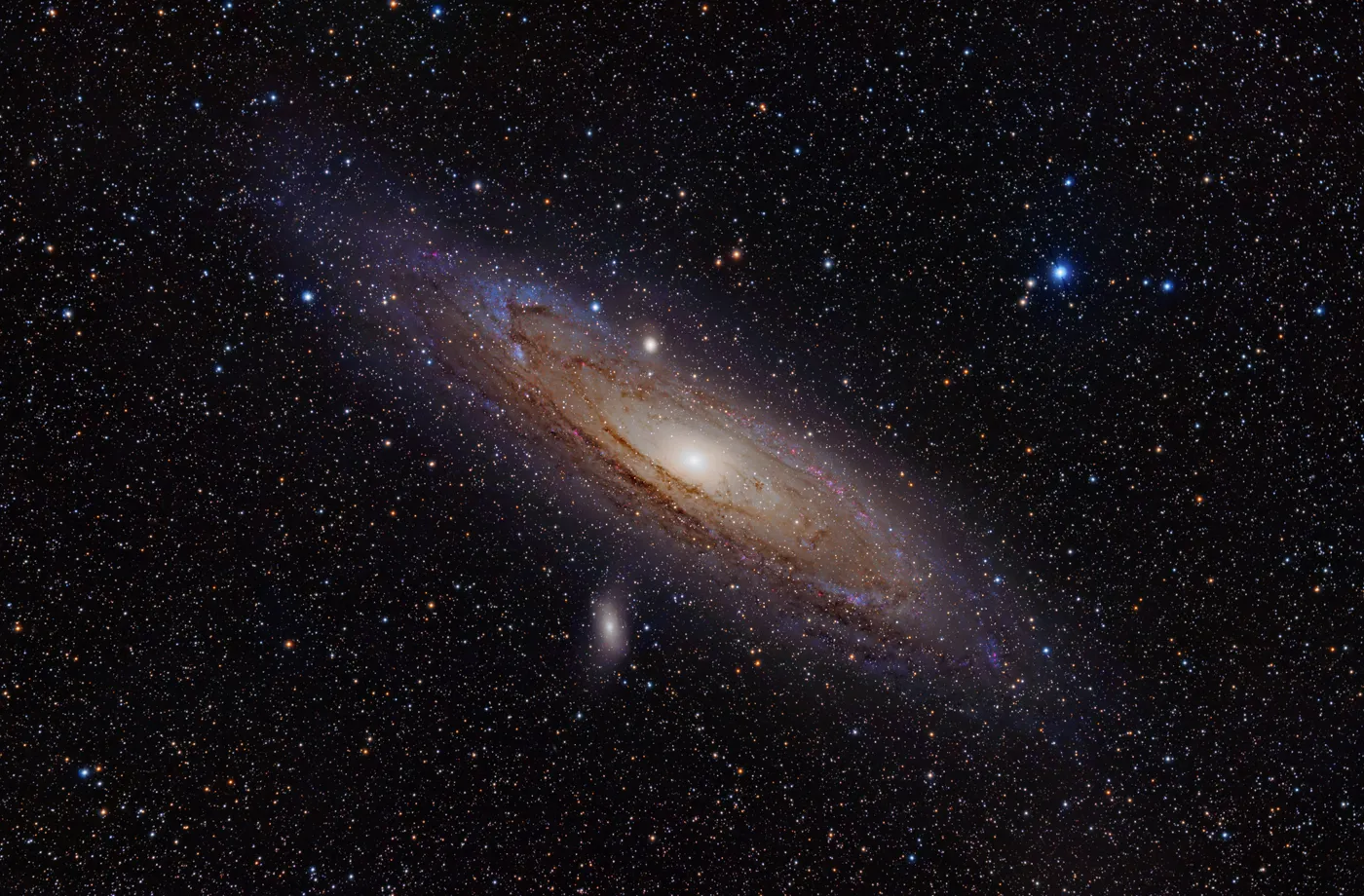
- The Andromeda Galaxy
- The Summer Triangle in the west
Pegasus is best seen in October at around nine in the evening. Between it and Cassiopeia lies the constellation Andromeda, and in it a faint misty smudge: an entire other galaxy.
Winter
- Orion with Betelgeuse and Rigel
- Sirius in Canis Major
- Aldebaran and the Pleiades in Taurus
- The Winter Hexagon
Winter evenings belong to Orion. Rigel, Aldebaran, Capella, Pollux, Procyon and Sirius form a huge hexagon, with Betelgeuse shining near its centre. Dress more warmly than you think you need to.
What is that light
Star, planet or the flight to London?
Not everything that shines at night is a star. Watch for half a minute and ask two questions: is it moving? And is it blinking?
Star
A point that twinkles and keeps its place among the other stars.
The twinkling is caused by restless air. A star is so distant that it is a mere point to us, and the atmosphere easily knocks a point about. It is strongest low over the horizon.
Planet
A bright point with a steady light that is missing from your star chart.
A planet is closer and shows a tiny disc rather than a point. The flickers average out across it, so it hardly twinkles. Look for it along the ecliptic, in Leo for instance.
Satellite
A fainter point sliding silently and evenly between the stars.
It has no light of its own and only reflects sunlight. That is why it is best seen a few hours after dusk or before dawn. It has no red and green navigation lights like an aircraft, though it may briefly flare.
International Space Station (ISS)
A very bright “star” that glides smoothly across the sky.
The brightest artificial object in the sky. It doesn’t flash, doesn’t change direction and travels at about 28,000 km/h, circling the Earth sixteen times a day. NASA’s Spot the Station app will tell you when it passes over you.
Aircraft
A moving point that blinks.
Flashing lights plus red and green on the wingtips give it away at once. It flies at around 965 km/h, far slower than the ISS, and it can turn.
Meteor
A quick streak of light. Gone before you can say “look”.
A “shooting star” is not a star. It is usually a grain no bigger than sand that lights up roughly 75 to 120 km above the ground and goes out in about a second.
You are looking into the past
Light travels at almost 300,000 km a second. The journey still takes time. So you see everything in the sky as it was when the light set off.
- Light takes1.3 seconds
The Moon
It is 384,400 km away on average. You are seeing it almost live.
- Light takesabout 8 minutes
The Sun
It is about 150 million km away. If it went out, you would not find out for eight minutes.
- Light takesjust over 4 years
Proxima Centauri, the nearest star
A red dwarf, too faint to see with the naked eye. Of the stars you can see from here, Sirius is among the closest: 8.6 light-years.
- Light takes2.5 million years
The Andromeda Galaxy
The nearest large galaxy and one of the most distant things you can ordinarily see with the naked eye. It spans six times the width of the full Moon in the sky, only very faintly. Its light set out long before our species existed.
How we worked it out
Two thousand years of looking up and being slightly less wrong each time
Constellations are old stories drawn on the sky. What we actually know about the stars comes from measuring. Twelve stops on the way from myth to a telescope beyond the Moon.
- c. AD 150
Ptolemy writes the sky down
Most northern constellations were invented in Mesopotamia and later by the Greeks. The Babylonian text MUL.APIN, probably compiled around 1000 BC, already lists stars and constellations. Around AD 150 Claudius Ptolemy summed them up in the Almagest: 1,022 stars in 48 constellations. He put the Earth at the centre of the universe, and the world believed him for more than 1,200 years.
Leo is one of the oldest constellations of all. The Greeks saw in it the Nemean lion, killed by Heracles as the first of his twelve labours.
- 1543
Copernicus moves the Sun to the centre
Nicolaus Copernicus’s book On the Revolutions of the Heavenly Spheres is printed in Nuremberg. In it the planets orbit the Sun and the Earth spins on its own axis. It appeared in the year of its author’s death. In 1616 the Church placed it on the Index of Forbidden Books.
- 1599–1609
Tycho and Kepler in Prague
The Danish astronomer Tycho Brahe measured the positions of stars and planets without a telescope, yet with unprecedented accuracy. In 1599 he came to Prague, to the court of Rudolf II. A year later Johannes Kepler joined him. Tycho died in Prague on 24 October 1601 and is buried in the Church of Our Lady before Týn. Kepler inherited his Mars measurements and, after ten years of calculation, published Astronomia nova in 1609: planets move in ellipses.
Tycho lost part of his nose in a duel in 1566 and wore a prosthetic one for the rest of his life.
- 1610
Galileo points a telescope at the sky
On 13 March 1610 the Starry Messenger is published in Venice. In it Galileo Galilei describes what he saw through an instrument magnifying twenty times: mountains on the Moon, a host of stars invisible to the eye and four moons orbiting Jupiter. He first spotted them on 7 January 1610. So not everything revolves around the Earth.
- 1687
Newton explains what holds it together
Isaac Newton publishes the Principia, with the laws of motion and the law of universal gravitation. Kepler’s ellipses fall out of them naturally. The same force that pulls an apple to the ground keeps the Moon in orbit.
Edmond Halley paid for the printing out of his own pocket. The Royal Society could no longer afford his salary, so it paid him in unsold copies of a book on the history of fishes.
- 1781
A musician discovers a planet
On 13 March 1781 William Herschel, a musician and composer in Bath, England, noticed an object he first took for a comet. It was Uranus, the first planet discovered since antiquity. His observations were written down by his sister Caroline, who discovered several comets herself. Four years later Herschel was the first to propose a shape for the Milky Way based on measurement: a disc.
- 1838
The first measured distance to a star
Friedrich Bessel measured the parallax of the star 61 Cygni in Cygnus, its tiny apparent shift caused by the Earth’s journey around the Sun. He got 10.3 light-years. Today’s value is 11.4. For the first time, humanity knew how far away the stars really are.
- 1912
Henrietta Leavitt finds a yardstick for the universe
At Harvard College Observatory she measured the brightness of stars on photographic plates. In the variable stars known as Cepheids she noticed that the brighter they are, the more slowly they pulse. The rhythm therefore reveals true luminosity, and from that distance, far beyond the reach of parallax. She died in 1921. Three years later a Swedish mathematician tried to nominate her for the Nobel Prize and only then learned she was no longer alive.
- 1923–1929
Hubble makes the universe bigger. Twice
In 1923 Edwin Hubble found a Cepheid in the Andromeda nebula and wrote “VAR!” beside the mark on his photographic plate. Using Leavitt’s rule he worked out that the star lay far beyond the edge of the Milky Way. The nebula was a galaxy in its own right. In 1929 he published the relation between the distance of galaxies and the speed at which they recede: the universe is expanding. The Belgian Georges Lemaître had got there two years earlier.
- 1965
The hiss left over from the Big Bang
In 1964 Arno Penzias and Robert Wilson picked up a faint hiss on an antenna at Holmdel in the United States. It came from every direction and would not go away. In July 1965 their paper appeared alongside an explanation by colleagues: it is radiation left over from the hot beginning of the universe. In 1978 they received the Nobel Prize.
At first they suspected the pigeons nesting in the antenna. They evicted them, cleaned out the droppings, and the hiss stayed.
- 1995
The first planet around another sun
In October 1995 Michel Mayor and Didier Queloz announced the planet 51 Pegasi b, a gas giant comparable to Jupiter. They found it at the Haute-Provence Observatory in southern France, in the region where van Gogh painted his stars. Its parent star lies in Pegasus, just over 50 light-years from us. In 2019 they received the Nobel Prize.
- 2021–2022
A telescope beyond the Moon
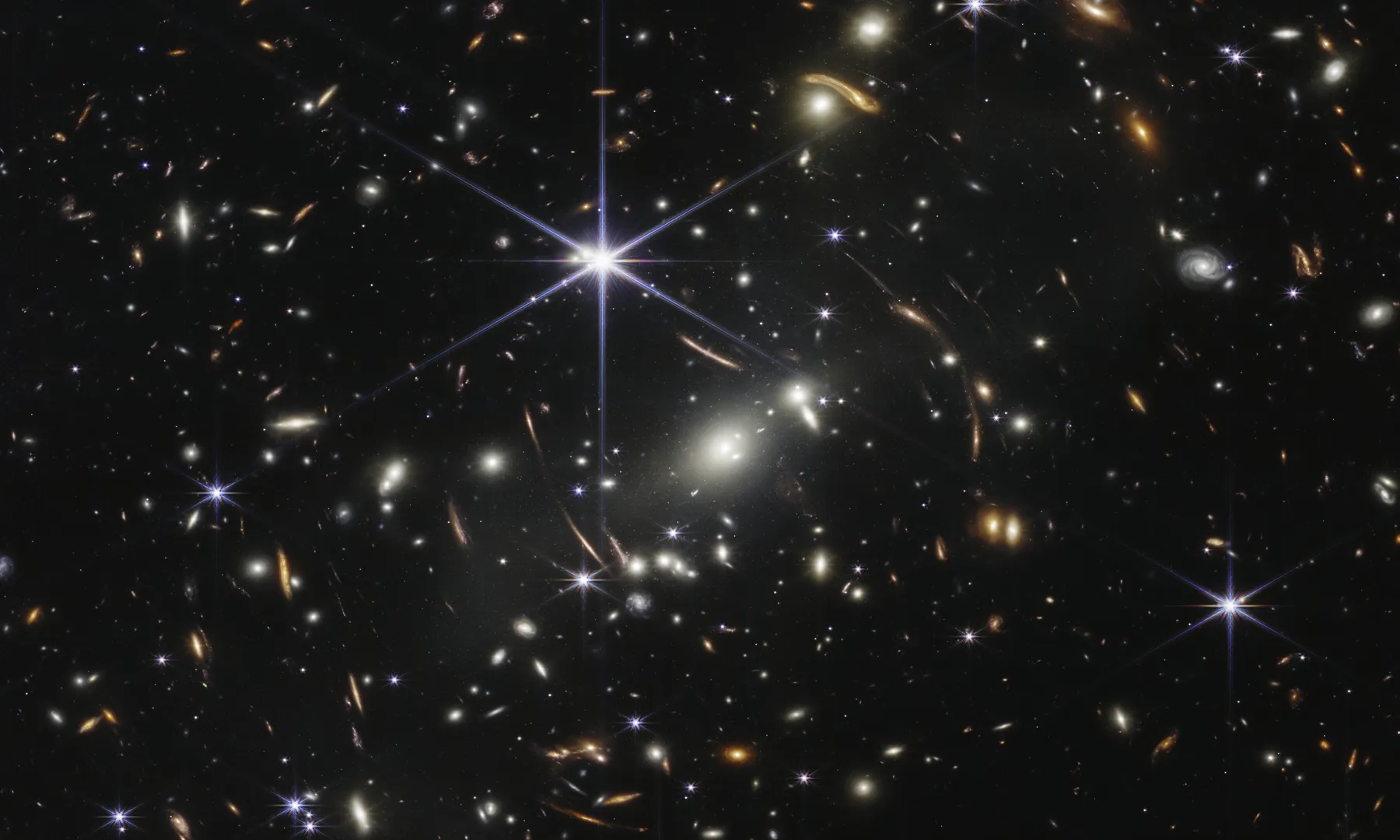
The James Webb Space Telescope launched on 25 December 2021 and works 1.5 million km from Earth. Its first full-colour images were released on 12 July 2022. In them, a patch of sky the size of a grain of sand held at arm’s length contains thousands of galaxies. The old question remains: what else are we not seeing?
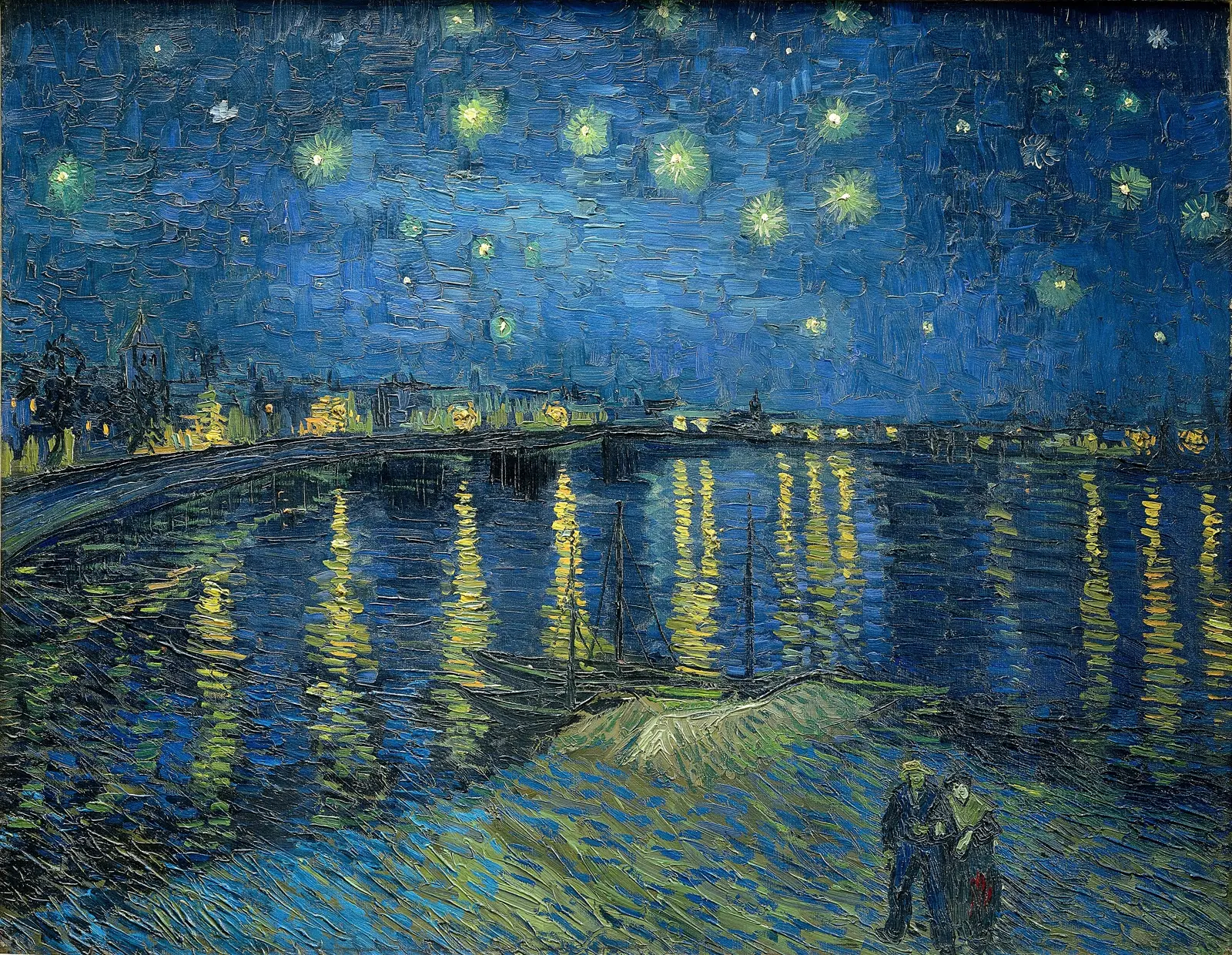
A painting under the lens
What in The Starry Night really comes from the sky
Van Gogh painted the famous Starry Night in mid-June 1889 at the asylum in Saint-Rémy. According to the Museum of Modern Art in New York, where it hangs, it was made in the daytime over several sessions. The village below the hills could not be seen from his window.
MoMA identifies the bright “star” left of centre as Venus. That fits a letter from early June in which Vincent told his brother he had seen the morning star from his window before sunrise and that it looked very big. In 1984 the art historian Albert Boime, using a sky reconstruction from the Griffith Observatory, concluded that the picture shows dawn on 19 June 1889.
The Moon does not fit, though. In those days it was between full and last quarter, so bulging, not the thin crescent on the canvas. In 1986 the astronomer Charles Whitney leaned towards the view that the picture combines observations from several nights. So the consensus runs roughly like this: Venus, probably yes; the Moon is artistic licence; and the swirls in the sky cannot be pinned on any known phenomenon with certainty.
Can you read the sky yet?
Eight questions on what you have just read. No marks given.
Dawn
The stars haven’t gone out. Someone just turned on the light
The sky pales in the east and twilight runs in reverse: astronomical, nautical, civil. The faintest stars go first; the brightest last almost until sunrise. They haven’t gone anywhere. They are there in the daytime too, outshone by one very nearby star.
Go outside tonight, wait half an hour and find the Big Dipper. From it, Polaris. Then just keep going. The map is right above your head.
I have loved the stars too truly to be fearful of the night.
Though my soul may set in darkness, it will rise in perfect light; I have loved the stars too truly to be fearful of the night.
The original 1868 edition reads “too truly”. The widespread “too fondly” differs from the original edition.
 Starry NightConstellation Atlas: Who is Who in the Night Sky
 Starry NightFirst Night Out: From the Dark Behind the House to Your First Galaxy
 Starry NightWhere to Find Darkness: Places Where Night Still Looks Like Night