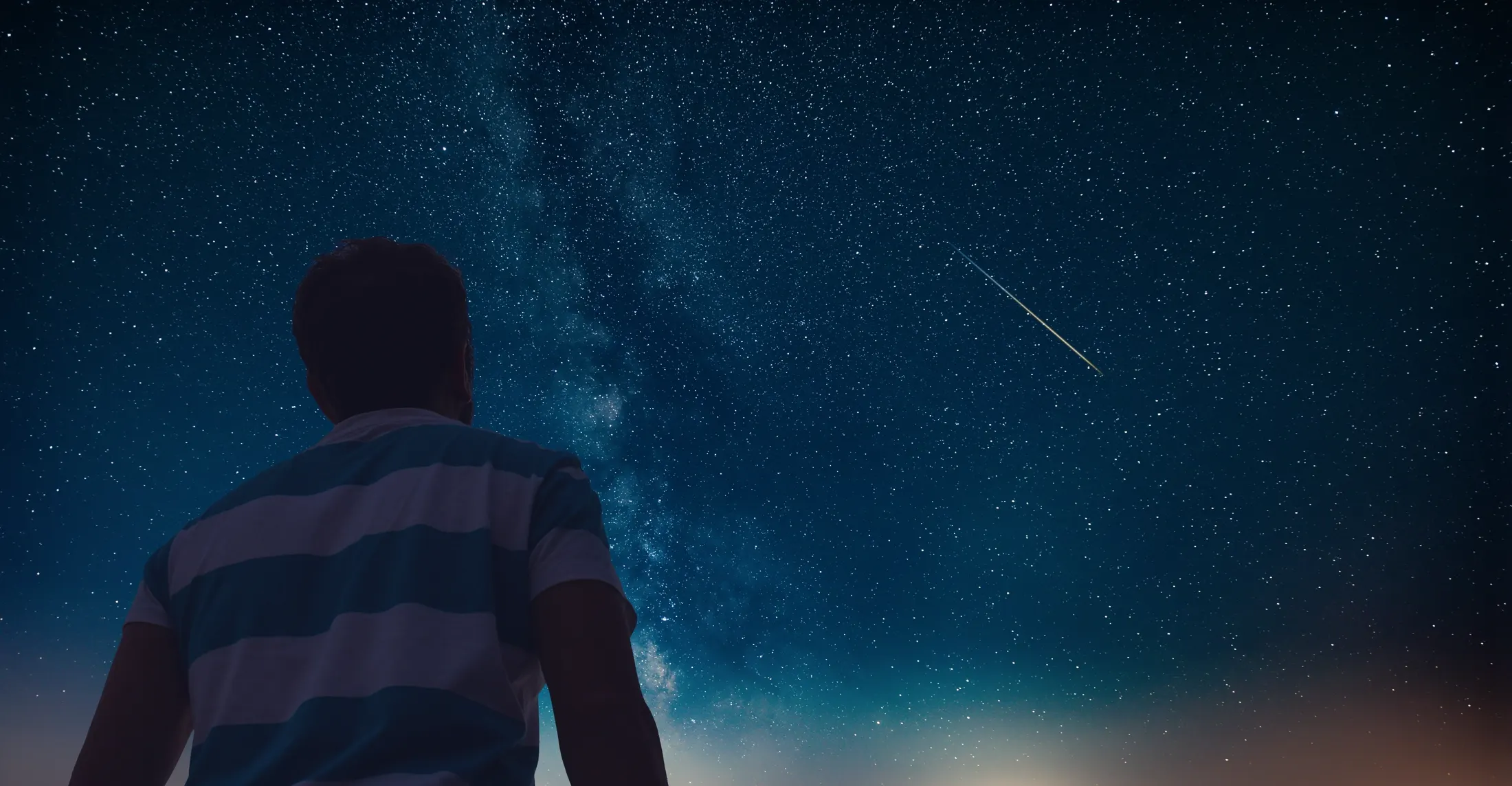
First Night Out: From the Dark Behind the House to Your First Galaxy
Astronomy is the only hobby where the most important piece of kit is switching the light off.
When to go, what to bring, how to look and what to fit into the first hour.
For your first night under the stars you do not need a telescope. You need darkness, a little patience and a warmer jacket than you think. The best way to begin is the oldest one: with your own eyes.
This page takes you through five things: when to go, what to bring, how eyes work in the dark, what to do in the first hour and how to behave while you are at it. We do not promise you will know the whole sky straight away. We do promise you will stop getting lost in it.
Step 1: when
When to Go: Moon, Weather and Season
The stars are in the sky every night. How many of them you see depends on three things you can find out in advance.
The Moon
The Moon is the biggest street lamp we know. At a dark site it shines so strongly that faint objects such as the Andromeda Galaxy or the Milky Way get lost in its light. For faint things, pick evenings around new Moon, or a time when the Moon has not yet risen or has already set. Bright stars and constellations do not mind the Moon so much. And the Moon itself is a splendid target in binoculars.
Weather and transparency
A clear sky is a condition, not a guarantee. It also matters how clean the air is: haze and humidity scatter the light of towns and take away the faint stars, especially low above the horizon. If you are not sure, step outside and count the stars in the bowl of the Little Dipper. Four means a good night.
The season
In winter it gets dark early, so you can observe straight after dinner and be in bed by ten. You pay for it in cold. Summer is pleasant, but darkness comes late. Around the summer solstice, in northern Slovakia and practically all of Czechia, full astronomical night does not arrive at all for several days: the Sun stays too shallowly below the horizon. Conditions are better in August. Spring and autumn are a sensible compromise between darkness and warmth.
Step 2: kit
Kit: From Nothing to Binoculars
Good news for your wallet: the first levels of kit cost next to nothing. A telescope comes into it only once you know where to point it.
Level 0: nothing
Your own eyes are the widest-angle instrument you will ever own. Constellations, the Milky Way, meteors and the Andromeda Galaxy are all things for the naked eye. Start with nothing and you will find out what you really miss.
Level 1: a red torch
The rods in your eye, which see in the dark, are barely sensitive to red light. A dim red torch therefore lets you read a map and see your feet without wrecking your night vision. The key word is dim: even red light, if strong, spoils dark adaptation. A head torch with a red mode is ideal.
Level 2: a sky map
A planisphere is a paper wheel on which you set the date and hour, and it shows you what is above the horizon right now. It never runs flat and it does not glow. A phone app is more convenient, but only in night (red) mode with the brightness turned right down. Otherwise a single glance at the screen sends your eyes back to square one.
Level 3: binoculars
An ordinary pair of binoculars is an excellent first instrument. The first number is the magnification, the second the diameter of the lenses in millimetres: 7×50 magnifies seven times through fifty-millimetre lenses. Anything from 7×35 to 10×50 will do. A 7×50 pair delivers a beam of light about 7 mm wide, roughly as wide as your pupil opens in the dark. Bigger, more powerful models are heavier, have a narrower field of view and shake in your hands.
Why not a telescope straight away
A telescope shows a small piece of sky, so you will find nothing in it until you know the sky. A beginner then has to learn the instrument and the stars at once, and usually gives up. Binoculars show a large field you cannot get lost in; the whole of the Pleiades and the Andromeda Galaxy fit inside. And when you do buy a telescope one day, the binoculars will go on serving you as a finder.
Clothes and comfort
When observing you stand or lie without moving, so you feel far colder than on a walk in the same weather. Even after a hot day it cools down at night, markedly so in the mountains. Take one more layer, a hat and a blanket: it works for wrapping up and as a ground sheet, which is the best place to look from. A reclining chair is a luxury your neck will appreciate.
Pack your kit
Choose how serious you are. We will show you what not to go without, what is worth adding later and what can happily stay in the shop.
How serious you are
The whole kit fits in your jacket pockets. Do actually bring the jacket, though.
Don’t go without
- Warm clothes, one layer more than seems reasonable
- A dim red torch or a head torch with a red mode
- A planisphere or an app in night mode
- A blanket or a sleeping mat
- A phone with the brightness turned right down
Worth adding later
- Binoculars, quite possibly the pair you already have at home
- A flask of something hot
- A folding recliner
- A notebook and a pencil
Leave for now
- A cheap supermarket telescope
- A powerful white head torch
- A laser pointer
Binoculars are an instrument you never give up, even once you buy a telescope. The hard part is not buying the biggest pair straight away.
Don’t go without
- Binoculars in the 7×35 to 10×50 range
- A red head torch to keep your hands free
- Both a planisphere and an app, one for the overview, one for detail
- A recliner or a mat, because you cannot hold binoculars overhead for long
- Winter clothing even in summer if you are heading for the mountains
Worth adding later
- A tripod with a binocular adapter
- A paper star atlas
- A visit to an observatory or astronomy club where you can try telescopes out
Leave for now
- Giant binoculars you cannot hold without a tripod
- A telescope bought on the strength of the magnification printed on the box
- Astrophotography gear
‘He said he was just popping out to look at the stars. He took a flask, a blanket, a recliner and two hats.’
Step 3: eyes
Eyes in the Dark: An Instrument That Needs to Warm Up
The eye works differently in the dark than by day, and it takes a while to switch over. Anyone who knows this sees far more stars than someone who has just stepped out of a car.
Dark adaptation
Your retina has two kinds of cell. Cones see colour and need plenty of light. Rods cannot tell colours apart but are far more sensitive. In light, the pigment rhodopsin inside them breaks down, and in the dark it has to be rebuilt. Cones adjust in about ten minutes; rods need half an hour or more. So allow 20 to 30 minutes before you see really well.
One glance and you start again
A single glance at a bright white light can undo your adaptation, and you wait another quarter of an hour. Car headlights, a friend’s head torch and a phone screen all count. Hence the red light, hence the dimmed screen, and hence standing with your back to the nearest lamp.
Averted vision
The strangest trick of the night sky: you see a faint object better when you do not look straight at it. The centre of the retina, which you use for looking directly, has almost no rods. Most of them sit a little to the side. Aim your gaze slightly to one side of a faint nebula or cluster and keep your attention on it. Suddenly it brightens. Look straight at it and it vanishes. Nothing is wrong with your eyes; that is how they are built.
What needs no adaptation
You do not have to wait for the Moon and the bright planets; they are visible at once. If you want to fit both the Moon and faint objects into one evening, leave the Moon till last. Its light will reliably spoil your adaptation.
Step 4: the plan
Your First 60 Minutes Under the Stars
A simple plan for the first night. It works in any season; only what you find in step four changes.
- 0–10 min
Lights off and do nothing
Find a spot with a view and as few lights as possible. Switch off everything that glows, turn your back to the nearest lamp and put on your last layer. Then just look up. The stars will multiply by the minute.
- 10–20 min
Find north
Find the Big Dipper. Extend the line through the two stars of the bowl’s outer wall, from Merak through Dubhe, about five times and you are at Polaris. Straight down from it to the horizon is north. From now on you know your compass points, and the map starts to make sense.
- 20–30 min
Cassiopeia and a darkness test
On the opposite side of Polaris from the Big Dipper, find the letter W: Cassiopeia. Then go back to Polaris and try to trace the whole Little Dipper. How many stars can you see in its bowl? That is tonight’s gauge of the darkness, and of how far your eyes have got with adapting.
- 30–40 min
One big pattern of the season
In spring, follow the curve of the Big Dipper’s handle to Arcturus and on to Spica. In summer, find the Summer Triangle: Vega, Deneb and Altair. In autumn, the Great Square of Pegasus. In winter, Orion with the three stars of his Belt. One pattern is enough. Add the surrounding stars only afterwards.
- 40–50 min
One gem in binoculars
Now your eyes are ready for faint things. Pick one to suit the season: Mizar and Alcor in the Big Dipper’s handle at any time, the cluster M13 in Hercules in summer, the Andromeda Galaxy in autumn, the Pleiades or the Orion Nebula in winter. If you have no binoculars, try with the naked eye and averted vision.
- 50–60 min
Lie back and look
Put the map down, lie on the blanket and do nothing for ten minutes. If it is summer and dark, you will see the band of the Milky Way from horizon to horizon. A meteor or a satellite may pass over. Finally, jot down what you found. Next time you start where you finished today.
Step 5: manners
Good Manners in the Dark
Darkness is shared. Spoil it for yourself and you spoil it for everyone around, people and animals alike.
Lights
Among observers you use only dim red light, and even that pointed at the ground. Never shine a light in anyone’s face or into a telescope. If you need white light, say so out loud first so the others can cover their eyes. Save flash photography for another time.
Cars
If other people are already at the site, try to arrive before dark. Park so that you do not have to sweep your lights over the observers when you leave, and switch off the interior light that comes on when a door opens. Before leaving, let people know you are about to start the engine. And do not block tracks or field gateways; fire engines and tractors need them at night.
Nature
The night belongs to the animals; you are a guest. Keep quiet, leave nothing behind and do not light a fire where it is not allowed. National parks and protected areas have their own rules about moving around and staying overnight after dark. Find them out in advance from the area’s administration.
Other people’s land
The meadow behind the village has an owner. Stay out of fenced or signposted land, do not trample crops, and ask beforehand if you can. A person with a torch in someone else’s field at midnight raises questions. A person who came by in daylight to introduce themselves often gets a tip for a better spot as well.
Checklist for the First Night
Tick off what you have. Better to find out what is missing at home than on a hilltop at eleven at night.
0 / 12 done
Five Mistakes Nearly Everyone Makes
Going at full Moon and expecting the Milky Way
A full Moon is lovely, but in its light you will not see faint objects even from the darkest site. For the Milky Way and galaxies, choose nights without the Moon.
Using your phone as a light
Half an hour of adaptation can be destroyed by one message at full brightness. Switch to night mode before you get out of the car, not after the screen has dazzled you.
Buying a telescope before you know the sky
Most people who think they want a telescope would be better served by binoculars for the first year. With them you learn where things are. The telescope will then not end up as an expensive coat stand in the corner.
Dressing as if for an evening stroll
Anyone frozen after twenty minutes leaves before their eyes have had time to adapt. Observing means standing still. Dress accordingly.
Wanting the whole sky in one night
First find one striking pattern and only then add the stars around it. Three constellations you really recognise are worth more than twenty that an app showed you and you had forgotten by morning.
 Main storyStarry Night: How to Learn to Read the Sky
 Starry NightConstellation Atlas: Who is Who in the Night Sky
 Starry NightWhere to Find Darkness: Places Where Night Still Looks Like Night