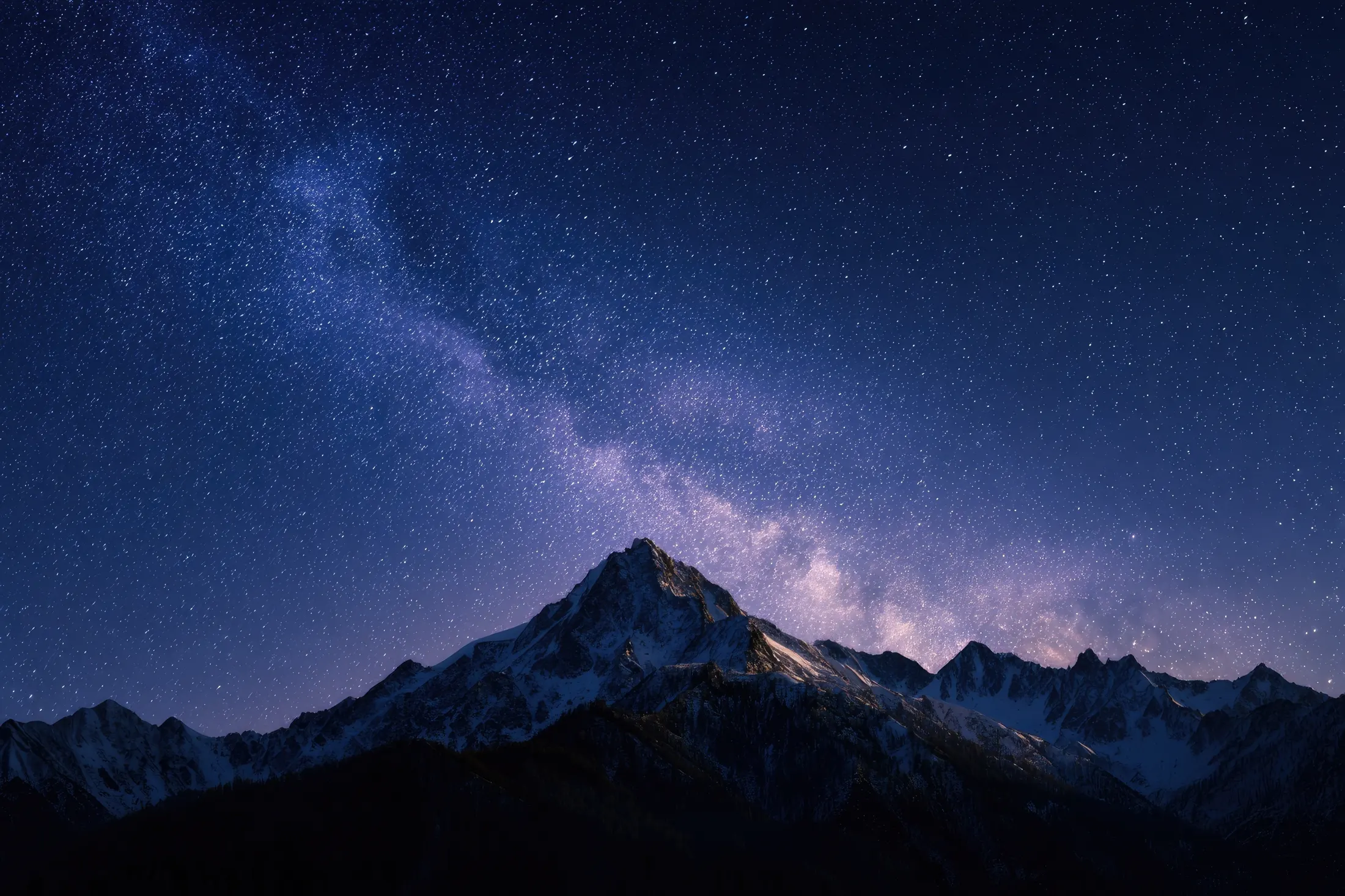
Where to Find Darkness: Places Where Night Still Looks Like Night
These days people travel to find darkness. It sounds odd until the first time you see a sky with so many stars that you cannot find the Big Dipper among them.
Six declared dark-sky areas and three observatories where someone will show you the sky.
In towns you can see a few dozen to a few hundred stars on a clear night. At a really dark site around two thousand are visible to the naked eye at once, and the Milky Way with them. The difference is not the air or the altitude but the light that shines needlessly upwards from the ground.
Czechia and Slovakia were among the first countries in Europe where astronomers, foresters, conservationists and municipalities began to protect darkness on purpose. Dark-sky areas and parks here are created by signing a memorandum: the partners agree to protect the night environment and to show it to people. For a visitor it means one thing. This is a place where it pays to look up.
We have picked six declared areas and three observatories for those who would rather see the sky with a guide first. It is not a ranking. Darkness is wherever there are no lamps, and you can often find it half an hour from home.
Nine Places on One Map
Click a point to see what awaits you there. The map shows the approximate centre of each area, not its boundaries. Always check the rules for visiting national parks and protected areas with the area’s administration.
-
1
Declared dark-sky area · north-eastern Slovakia, Snina district
Poloniny Dark-Sky Park
The first darkness Slovakia chose to protect
Why go. The first declared dark-sky area in Slovakia, in the corner of the country by the borders with Poland and Ukraine. It takes in the national park, its buffer zone and the land of five villages, more than 48,000 hectares in all, with an exceptionally well-preserved night environment.
Tip. The park includes the land of the village of Kolonica, above which stands the astronomical observatory at Kolonické sedlo. On a first visit, start there.
‘It is so dark in Poloniny that you only find your torch if you remember which pocket you put it in.’
-
2
Declared dark-sky area · central Slovakia, north-west of Banská Bystrica
Veľká Fatra Dark-Sky Park
Darkness in the middle of Slovakia
Why go. The third area in Slovakia where the night environment and darkness are deliberately protected. It lies in the middle of the country, which makes it the most accessible declared darkness for a large part of Slovakia.
‘By day people come here for the views. By night they come because no view can be seen at all.’
-
3
Declared dark-sky area · the Gemer and Horehronie regions, Muránska planina National Park
Muránska planina Dark-Sky Park
The youngest dark-sky park
Why go. The fourth place in Slovakia to carry a dark-sky designation. The memorandum was signed at the Zbojská saddle between Tisovec and Pohronská Polhora, and public observing sessions are run by staff of the observatory in Rimavská Sobota.
Tip. In July and August the sessions are held at Veľká lúka; in spring and autumn, when it gets dark earlier, at Predná Hora and at Zbojská, where you can also stay the night.
‘The youngest dark-sky park has one advantage: its darkness is just as old as everywhere else.’
TASR news agency: a dark-sky park is created on Muránska planina (May 2024) ↗Back to the map ↑
-
4
Declared dark-sky area · Jizera Mountains, Czech–Polish border
Jizera Dark-Sky Area
Darkness that knows no borders
Why go. The first dark-sky area in Czechia and the first cross-border one in the world. It covers just under 75 square kilometres in the upper Jizera valley and the Jizerka valley.
Tip. The centre of the area is the hamlet of Jizerka. The area is signposted on the main access roads, and in August it hosts the public event Den a noc na Jizerce (Day and Night at Jizerka).
‘The stars over Jizerka do not ask which side of the border you are standing on. They shine the same in Czech and in Polish.’
-
5
Declared dark-sky area · Moravian-Silesian Beskids and Kysuce, Czech–Slovak border
Beskydy Dark-Sky Area
The darkness Czechs and Slovaks share
Why go. A Czech–Slovak area of 308 square kilometres centred on the villages of Staré Hamry and Bílá. The night sky of the Beskids is among those least disturbed by artificial light in Czechia, and the area extends into Slovakia’s Kysuce region.
Tip. The area was declared at the Švarná Hanka mountain hut on Gruň in Staré Hamry, right at its centre.
‘In the Beskids, Czechs and Slovaks still share one darkness. So far without any dispute over who owns which star.’
Lesy ČR: partner of the Czech–Slovak Beskydy Dark-Sky Area ↗Back to the map ↑
-
6
Declared dark-sky area · West Bohemia, north of the Plzeň Region
Manětín Dark-Sky Area
Darkness without mountains
Why go. The third Czech dark-sky area, and proof that you need not climb a ridge to find darkness. On 346 square kilometres the population density is about a tenth of the Czech average, there are no large towns or industry, and measurements show the sky to be about as dark as in the mountains.
‘The Manětín area has a tenth as many people as elsewhere. The number of stars is about the same; you can finally see them, that is all.’
West Bohemian branch of the Czech Astronomical Society: declaration of the Manětín Dark-Sky Area ↗Back to the map ↑
-
7
Observatory · Kolonica, Snina district, inside Poloniny Dark-Sky Park
Kolonické sedlo Astronomical Observatory
An observatory right in the dark
Why go. The observatory of the Vihorlat Observatory in Humenné stands right inside Poloniny Dark-Sky Park. It offers tours, planetarium programmes and evening observing sessions, so here the darkness comes with a commentary.
Tip. Check the programme and dates of evening sessions on the observatory’s website in advance. The weather always has the last word.
‘It is a long way to Kolonické sedlo. The light from the Andromeda Galaxy had a longer one and did not complain.’
-
8
Observatory · Hurbanovo, Komárno district, southern Slovakia
Slovak Central Observatory, Hurbanovo
Where astrophysics began in Slovakia
Why go. The observatory was founded in 1871 by Miklós Konkoly-Thege as one of the first astrophysical observatories in Europe. Today it has a planetarium, the Konkoly museum and evening observing for the public. It is not a dark sky, but it is a good place for a first look through a telescope.
Tip. Evening observing is combined with a planetarium programme. Check the visiting hours on the observatory’s website.
‘Konkoly gave the observatory to the state on condition that it stayed in Hurbanovo. Some contracts are worth honouring even a hundred years on.’
-
9
Observatory · Ondřejov, Prague-East district, Central Bohemia
Ondřejov Observatory
The largest telescope in Czechia
Why go. A site of the Astronomical Institute of the Czech Academy of Sciences with a two-metre reflecting telescope, the largest in Czechia. From May to September it runs weekend tours taking in the historic domes and Art Nouveau grounds. It is a daytime visit, not night observing, but you see what the science looks like that studies those same stars professionally.
Tip. A tour takes about two hours and involves roughly a kilometre and a half of walking. Current dates are on the institute’s website.
‘They will not let you borrow the two-metre telescope. We recommend not asking more than twice.’
Astronomical Institute of the Czech Academy of Sciences: public tours ↗Back to the map ↑
The Best Darkness Is the One You Can Get To
The declared areas are an experience worth travelling for. But you do not need them for your first constellations. A meadow behind the village, a hill above the town or a cottage where nobody has a light on in the evening will do.
And when you come home one day from Poloniny or Jizerka, look at the sky above your own street. The stars will be the same ones. There will just be fewer of them, and by then you will know why.
‘Anyone who says there is nothing to see at night has never properly switched the lights off.’
 Main storyStarry Night: How to Learn to Read the Sky
 Starry NightConstellation Atlas: Who is Who in the Night Sky
 Starry NightFirst Night Out: From the Dark Behind the House to Your First Galaxy