Quietly Mad? Welcome to the World of Anglers
Who Actually Lives in Our Waters?
Stop by a pond and you see water. Now and then rings on the surface, the back of a fish or a movement among the plants. What goes on underneath stays hidden.
An angler knows that the residents of the same water do not all live the same way. The pike lurks in cover, the carp works the bottom, the perch patrols the snags and the barbel is at home in a current the tench would hate. Every species has its own needs, its own strategy and its own weak spots.
The Carp Family: Not Always as Peaceful as They Look
Five fish that live off what they find on the bottom and among the plants.
-
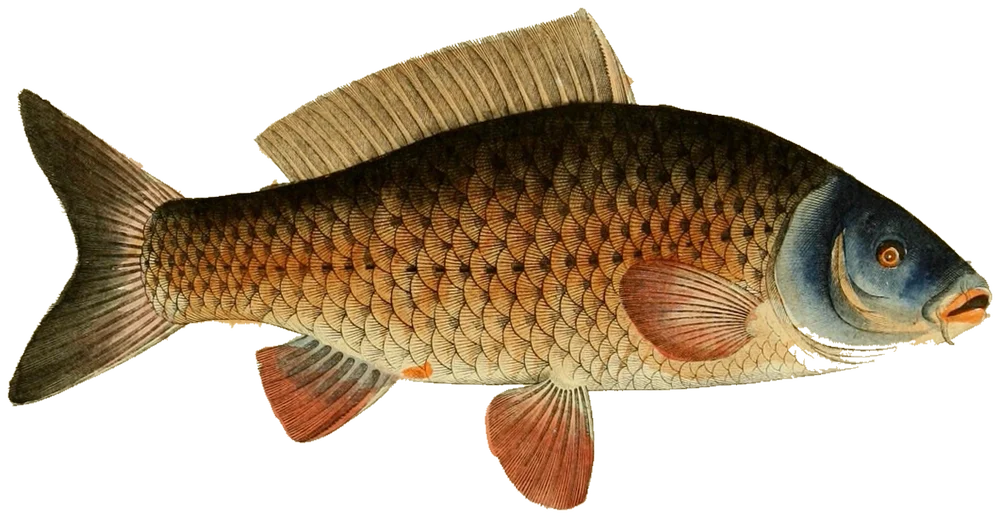
Common carp
Cyprinus carpio
A Christmas tradition for some. A long-term strategic opponent for others.
How to recognise it. A sturdy body, a long dorsal fin and an extendable mouth with two pairs of barbels. Olive-brown to golden. Farmed forms differ in scaling: fully scaled, mirror and almost scaleless leather carp.
Where it lives. Warm still and slow-flowing waters: ponds, reservoirs, lakes and lowland rivers. It likes a soft bottom, water plants and plenty of food.
What it eats. An omnivore. It roots through the bottom for insect larvae, worms and molluscs, and takes plants too. All that digging stirs up the mud and can cloud shallow water.
When it is active. Water temperature, weather and food supply decide. It often feeds at dusk and at night, though not only then. In cold water its metabolism slows and it eats very little.
How it is caught. By ledgering, on the feeder and on the float. The classic baits are boilies, pellets and sweetcorn.
Worth knowing. The carp’s wild ancestor is native to the Danube basin. It has been farmed in Central European ponds since the Middle Ages and is the traditional Christmas Eve dish in Slovakia and Czechia. Big old carp can be extremely wary.
Conservation. Native to the Danube basin (the wild form is now rare); elsewhere in Central Europe farmed and stocked for centuries.
Length and weight
usually 40–70 cm · up to 129 cm
A rough estimate from the length–weight relationship (FishBase). A real fish can weigh noticeably more or less.
-
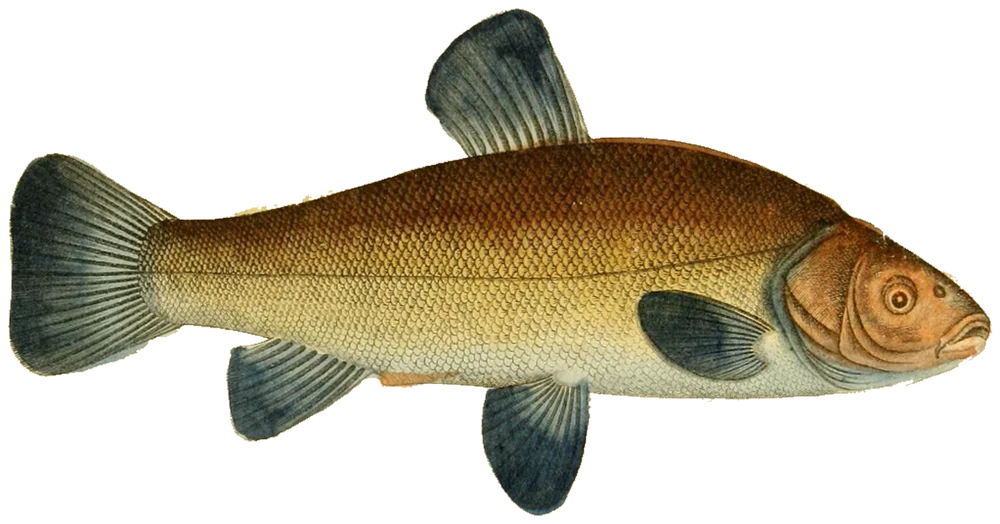
Tench
Tinca tinca
A calm gentleman at first sight. On the line, a specialist in escaping into the water lilies.
How to recognise it. A thickset body with tiny scales under a thick coat of slime, olive-green to bronze. Small eyes with a red-orange iris, rounded fins and one pair of small barbels at the corners of the mouth.
Where it lives. Calm, warm, weedy waters with a muddy bottom: ponds, pools, oxbows and quiet bays.
What it eats. It feeds on the bottom: insect larvae, snails, small mussels, worms and crustaceans, with the odd bit of plant matter.
When it is active. A warmth-lover, most active in summer at dawn, at dusk and through the night. It tolerates water poor in oxygen and spends the winter almost motionless on the bottom.
How it is caught. On the float, a light ledger or the feeder. Worms and sweetcorn work well, presented right next to the weed.
Worth knowing. You can tell a male by his pelvic fins: they are larger, spoon-shaped and have a thickened second ray. On the line a tench is surprisingly strong and heads straight for the weed.
Conservation. Native species.
Length and weight
usually 25–45 cm · up to 70 cm
A rough estimate from the length–weight relationship (FishBase). A real fish can weigh noticeably more or less.
-
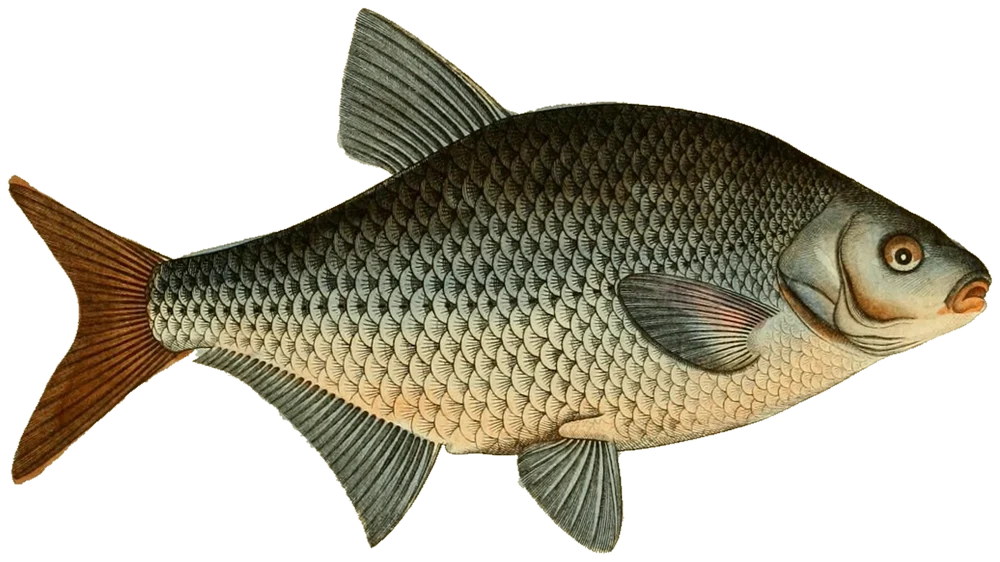
Common bream
Abramis brama
One bream is a pleasure. A whole shoal can keep an angler busy all morning.
How to recognise it. A deep, strongly flat-sided body and a small head. The mouth extends into a tube and the anal fin is strikingly long. Young fish are silvery, old ones bronze.
Where it lives. Lower rivers, reservoirs, lakes and larger ponds. It lives in shoals that work their way across large areas of the bottom.
What it eats. Small bottom animals – insect larvae, worms and molluscs – which it sucks out of the mud. Larger fish also feed on plankton.
When it is active. Shoals roam after food and like to return to proven feeding spots, often at dusk and at night. For the winter they move into deeper water.
How it is caught. On the feeder, the float and a light ledger. Accurate groundbaiting and a bait presented on the bottom make the difference.
Worth knowing. A whole stretch of river is named after it: the bream zone is the slow, warm lower course. It is also the classic match-fishing species – a shoal settling on your feed can decide the result.
Conservation. Native species.
Length and weight
usually 30–50 cm · up to 82 cm
A rough estimate from the length–weight relationship (FishBase). A real fish can weigh noticeably more or less.
-
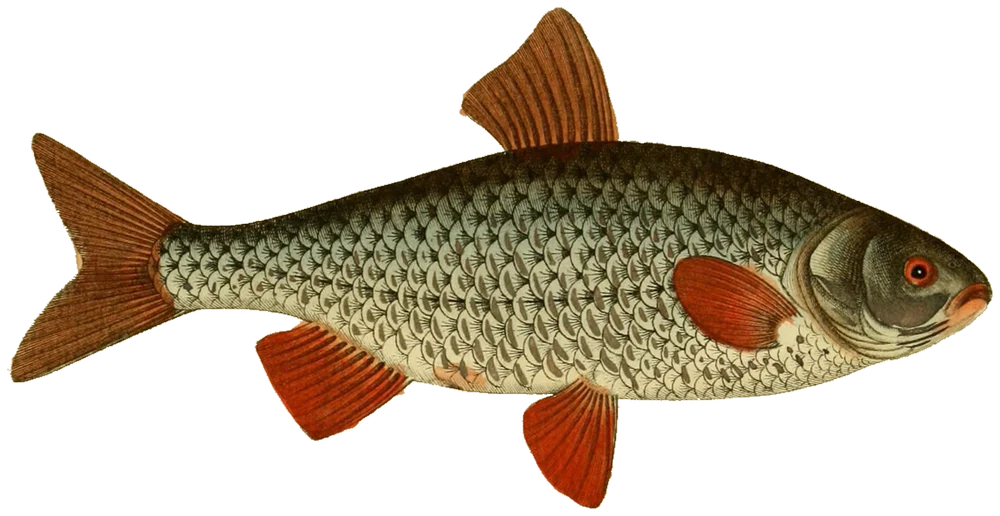
Roach
Rutilus rutilus
It may not have been your dream trophy. But it may well have been your very first fish.
How to recognise it. A silvery body, reddish lower fins and a red iris. The dorsal fin starts above the pelvic fins and the mouth points forwards. The similar rudd has its dorsal fin set further back and an upturned mouth.
Where it lives. Almost everywhere: ponds, lakes, reservoirs, oxbows and slower stretches of rivers. It keeps to shoals.
What it eats. Whatever is on offer: small invertebrates, insect larvae, algae, plants and organic debris.
When it is active. It feeds on the bottom, in mid-water and near the surface. In winter the shoals retreat to deeper, calmer places.
How it is caught. On the float and the feeder. It is a delicate game: a well-balanced float, a fine hooklength and a small bait.
Worth knowing. It is one of the most widespread fish in Europe and staple prey for pike, zander and perch. Without roach, half the predators in the water would go hungry.
Conservation. Native species.
Length and weight
usually 15–30 cm · up to 50 cm
A rough estimate from the length–weight relationship (FishBase). A real fish can weigh noticeably more or less.
-
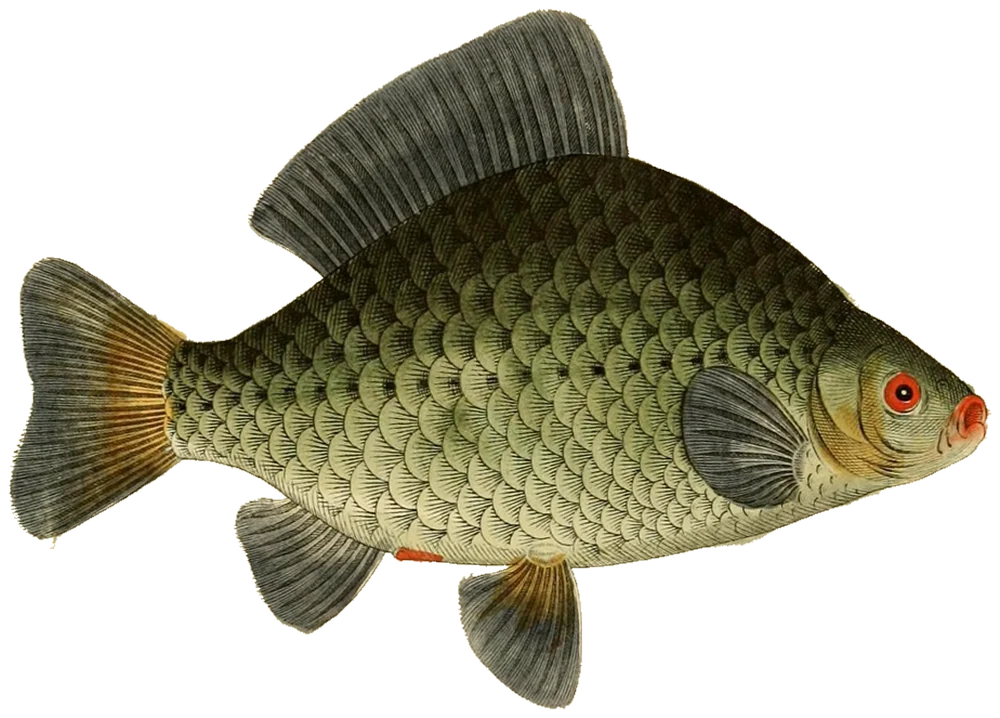
Crucian carp
Carassius carassius
A quiet master of survival who deserves more respect than the size of the catch suggests.
How to recognise it. A deep, golden-bronze body with no barbels. The edge of the long dorsal fin is convex. The non-native gibel carp is silver-grey and its dorsal fin has a straight or concave edge.
Where it lives. Small still waters: pools, old river arms and weedy little ponds – often where other fish cannot last.
What it eats. An omnivore: small invertebrates, insect larvae, plankton and plant debris.
When it is active. Active mainly in the warm part of the year. It sits out the winter torpid on the bottom, even under ice in water with almost no oxygen.
How it is caught. It takes a small bait on the float or a light ledger. It is not a target species, though – it is rare, so if you meet one, handle it gently.
Worth knowing. It can survive for months without oxygen: its body then turns lactic acid into alcohol and releases it through the gills. It is threatened by the loss of small pools and by hybridising with the non-native gibel carp (Carassius gibelio).
Conservation. Native species. Least Concern globally (IUCN), but declining fast in Central Europe; critically endangered on the Czech national red list.
Length and weight
usually 15–30 cm · up to 64 cm
A rough estimate from the length–weight relationship (FishBase). A real fish can weigh noticeably more or less.
Predators: Fish That Have Other Fish for Lunch
Five hunters and five different ways of getting at their prey.
-
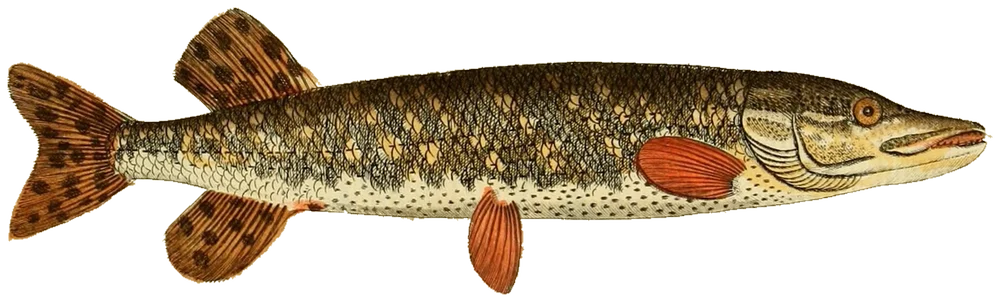
Northern pike
Esox lucius
The teeth are ready. Best not to count on a good mood.
How to recognise it. A long, slim body, a flattened head like a duck’s bill and a large mouth full of teeth. The dorsal fin sits far back near the tail. Greenish colouring with pale spots hides it among the plants.
Where it lives. Still and flowing waters alike. It keeps to weed edges, sunken branches and the border between open water and cover.
What it eats. Mainly fish, smaller pike included, but also frogs and now and then ducklings or small mammals. Young pike start on plankton and insects.
When it is active. It hunts from ambush and by sight, so it is active mostly by day. When it has to, it follows prey into open water. It spawns in early spring in flooded shallows.
How it is caught. By spinning with plugs, soft lures and spoons. You need a tough trace that its teeth cannot cut.
Worth knowing. Its teeth slant backwards, so prey slides in easily but not out again. Always use forceps to unhook one, and mind your fingers.
Conservation. Native species.
Length and weight
usually 50–90 cm · up to 150 cm
A rough estimate from the length–weight relationship (FishBase). A real fish can weigh noticeably more or less.
-
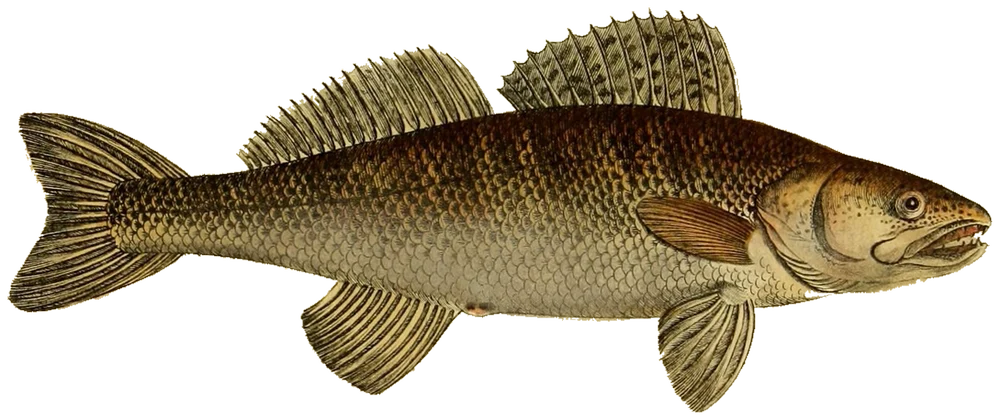
Zander
Sander lucioperca
While everyone else is settling down to sleep, he is only starting to think about dinner.
How to recognise it. An elongated body, two dorsal fins (the first spiny), large glassy eyes and long, conspicuous canine teeth. Dark vertical bars run down the grey-green flanks.
Where it lives. Larger rivers, reservoirs and lakes. It seeks deeper water, a hard bottom, drop-offs and snags, and does not mind murky water.
What it eats. Adults hunt smaller, slender fish. Young zander start on plankton and small aquatic animals.
When it is active. It hunts mostly at dusk and at night. A reflective layer in the eye helps it see in dim light and murky water.
How it is caught. By spinning soft lures close to the bottom. The take is often gentle – you have to feel it through the rod.
Worth knowing. The male clears a nest on the bottom and guards the eggs and fry until they swim away. That is exactly why zander are so vulnerable at spawning time.
Conservation. Native species.
Length and weight
usually 45–70 cm · up to 100 cm
A rough estimate from the length–weight relationship (FishBase). A real fish can weigh noticeably more or less.
-
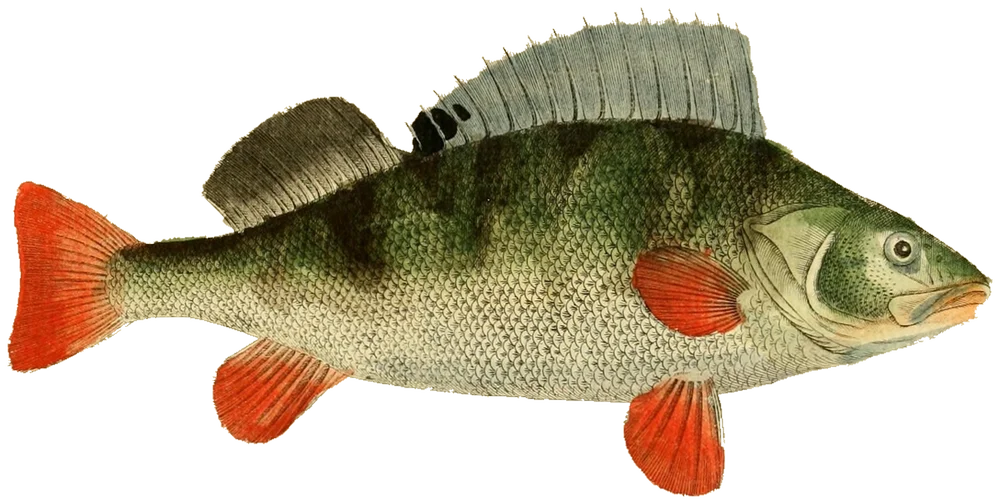
European perch
Perca fluviatilis
It may not impress you with its size. Its self-confidence often will.
How to recognise it. Dark vertical bars on the flanks, two dorsal fins – the first with sharp spines and a dark blotch at the rear – and orange to red pelvic and anal fins.
Where it lives. Ponds, lakes, reservoirs and rivers. It keeps close to stones, branches and plants. Smaller fish form shoals; big ones tend to be loners.
What it eats. Young perch eat plankton and small invertebrates; larger ones hunt small fish – their own relatives included.
When it is active. It hunts by day, mostly in the morning and early evening. A shoal can drive small fish up to the surface or against the bank together.
How it is caught. By spinning small soft lures, plugs and spinners, or on the float with a worm.
Worth knowing. It lays its eggs in long jelly-like ribbons draped over plants and branches. And take care when unhooking one: the dorsal spines are properly sharp.
Conservation. Native species.
Length and weight
usually 20–35 cm · up to 60 cm
A rough estimate from the length–weight relationship (FishBase). A real fish can weigh noticeably more or less.
-
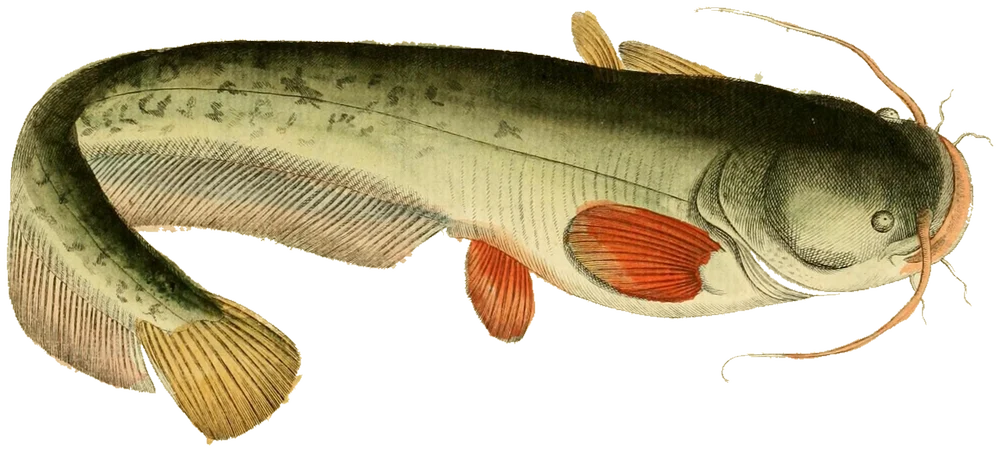
Wels catfish
Silurus glanis
The fish that makes you wonder whether your tackle really had to be quite so light.
How to recognise it. A long scaleless body, a broad flat head and an enormous mouth. It has three pairs of barbels: one long pair on the upper jaw and two short pairs on the chin. The anal fin is very long, the dorsal fin tiny.
Where it lives. Large rivers, reservoirs and lakes. By day it rests in deep holes and under snags; to feed it moves into the shallows too.
What it eats. Fish, crayfish, frogs and occasionally waterfowl or small mammals. Young catfish eat invertebrates.
When it is active. It hunts mainly at dusk and at night, especially in the warm part of the year. It spends the winter almost motionless in deep holes.
How it is caught. With catfish rigs on the bottom, by spinning or vertically from a boat. Big fish demand strong tackle and experience.
Worth knowing. It is one of Europe’s largest freshwater fish: exceptional specimens exceed 2.5 metres and 100 kilos. Its eyes are small; it finds prey with its barbels, by smell and by sensing vibrations in the water.
Conservation. Native species.
Length and weight
usually 80–150 cm · up to 273 cm
A rough estimate from the length–weight relationship (FishBase). A real fish can weigh noticeably more or less.
-
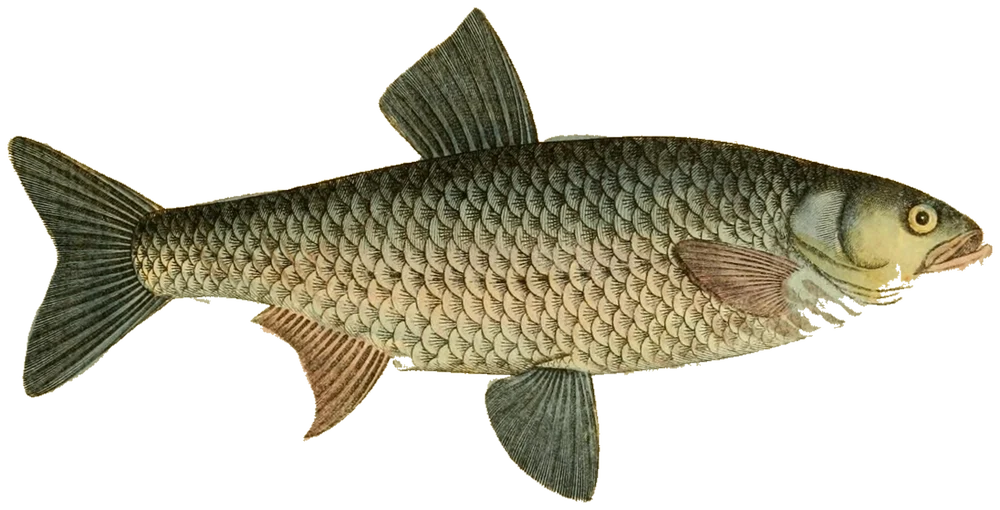
Asp
Leuciscus aspius
The carp’s relative who would rather order the fish than the sweetcorn.
How to recognise it. A long silvery body with small scales and a deeply forked tail. The large mouth reaches back below the eye, and a knob on the lower jaw fits into a notch in the upper one.
Where it lives. Larger rivers and reservoirs. It likes open water, current seams and the water below weirs, where shoals of small fish gather.
What it eats. Young asp eat plankton and insects. Adults hunt small fish near the surface, mostly bleak.
When it is active. It hunts by day and by sight, crashing into shoals of small fish just under the surface – the loud splash gives it away from a distance.
How it is caught. By spinning with artificial lures. It takes a long, accurate cast, a fast retrieve and an eye on the surface.
Worth knowing. The asp is a member of the carp family that turned predator. It has no teeth in its mouth, so it does not bite its prey but swallows it whole.
Conservation. Native species.
Length and weight
usually 45–70 cm · up to 120 cm
A rough estimate from the length–weight relationship (FishBase). A real fish can weigh noticeably more or less.
Trout and Grayling: At Home in Colder Water
Fish of clean, flowing, well-oxygenated rivers.
-
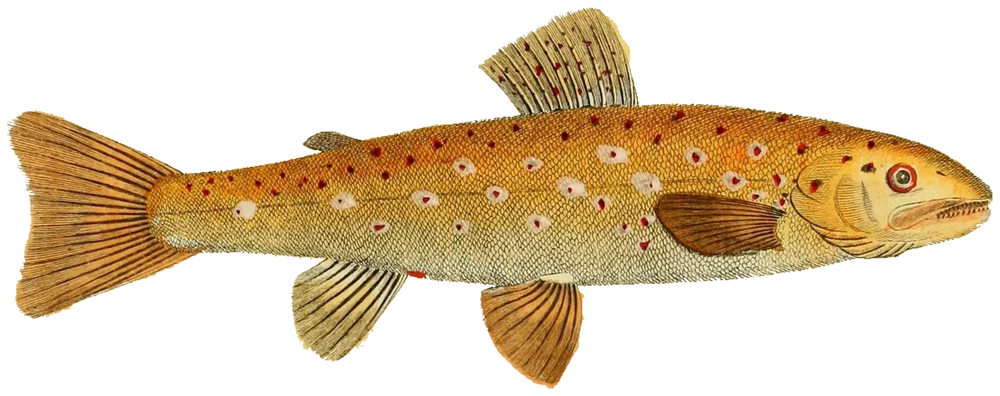
Brown trout
Salmo trutta
A discreet resident of the current who will very quickly teach you the difference between an accurate cast and an almost accurate one.
How to recognise it. A long, muscular body with dark and red spots, often ringed with a pale halo. There is a small adipose fin behind the dorsal fin, and the tail has few or no spots. Colour varies with the water – our streams hold the resident river form.
Where it lives. Cold, well-oxygenated streams and rivers with a gravel or stony bed. It needs cover – undercut banks, stones, roots.
What it eats. Aquatic and terrestrial insects and their larvae, and crustaceans. Large trout also take small fish.
When it is active. It holds a station where the current brings food and costs it as little effort as possible. It is liveliest in the morning and early evening.
How it is caught. By fly fishing and spinning. Reading the current, an accurate cast and a quiet approach to the water decide it.
Worth knowing. It spawns in autumn and winter. The eggs are buried in gravel, where they need flowing, oxygen-rich water – so silted-up riverbeds and warming water threaten its breeding.
Conservation. Native species. Sensitive to warming water and river engineering.
Length and weight
usually 20–40 cm · up to 140 cm
A rough estimate from the length–weight relationship (FishBase). A real fish can weigh noticeably more or less.
-
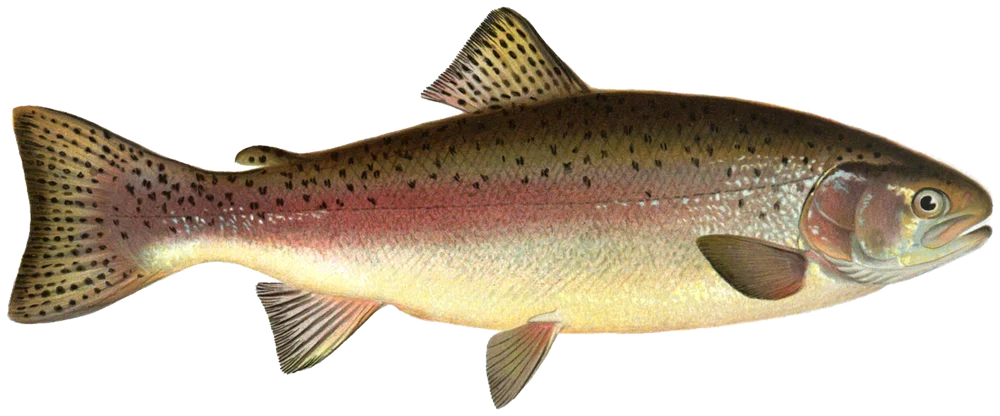
Rainbow trout
Oncorhynchus mykiss
An American immigrant who certainly did not come to European anglers just to say hello.
How to recognise it. A pink to reddish band runs along the flank. The body, dorsal fin and tail fin are peppered with small dark spots. Like all salmonids it has an adipose fin.
Where it lives. It comes from the Pacific drainages of North America and from Kamchatka. In Europe it has been farmed and stocked since the late 19th century. It prefers cool, oxygen-rich water but tolerates warmer water than the brown trout.
What it eats. Aquatic invertebrates, insects off the surface, crustaceans and, for larger fish, small fish too.
When it is active. An active hunter that feeds in mid-water and off the surface, often throughout the day.
How it is caught. By fly fishing and spinning, and on ponds and reservoirs on the float as well.
Worth knowing. Anglers love it for its fierce runs and leaps clear of the water. It rarely breeds in our waters; its numbers are kept up by stocking from fish farms. The form that runs to sea in its homeland is called steelhead.
Conservation. Non-native species (North America, Kamchatka); in Central Europe it depends on stocking.
Length and weight
usually 25–50 cm · up to 123 cm
A rough estimate from the length–weight relationship (FishBase). A real fish can weigh noticeably more or less.
-
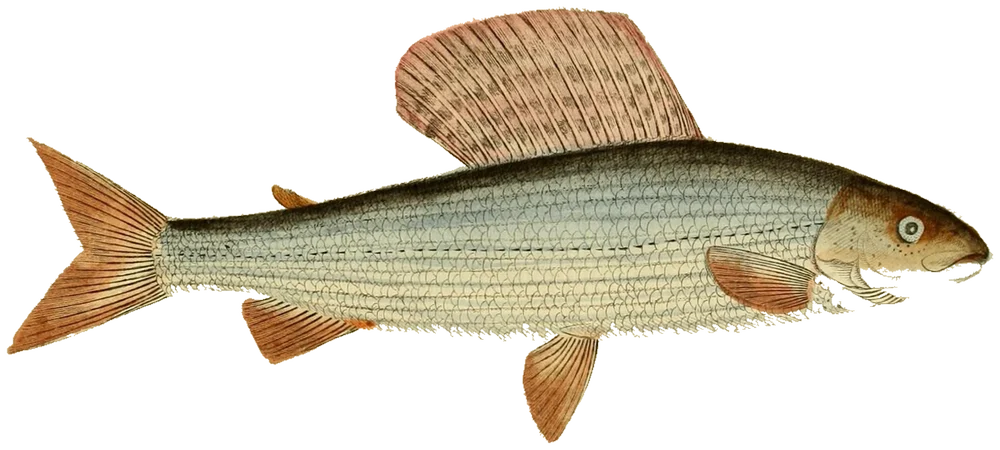
Grayling
Thymallus thymallus
Unremarkable until it spreads its dorsal fin. Then it is the aristocrat of the river.
How to recognise it. A slim silvery body and, above all, a tall sail-like dorsal fin with rows of dark spots – larger still in males. The mouth is small, and there is an adipose fin behind the dorsal fin.
Where it lives. Cold, clean upland rivers with a gravel bed. The stretch of river below the trout zone is named after it: the grayling zone.
What it eats. Aquatic insects and their larvae, small invertebrates and insects that fall onto the surface.
When it is active. It lives in groups and picks food carried by the current, on the bottom and off the surface. It stays active in the cold months too.
How it is caught. By fly fishing with nymphs and dry flies. The fly has to drift naturally, with no drag from the line.
Worth knowing. A freshly caught grayling is said to smell of thyme – hence its scientific name, Thymallus. Unlike the brown trout, it spawns in spring.
Conservation. Native species. Least Concern globally (IUCN), but its numbers are falling in Central Europe.
Length and weight
usually 25–40 cm · up to 60 cm
A rough estimate from the length–weight relationship (FishBase). A real fish can weigh noticeably more or less.
Curious Residents of Rivers, Pools and Reservoirs
A strongman of the current, a herbivore from Asia, an ocean pilgrim and a fish from prehistory.
-
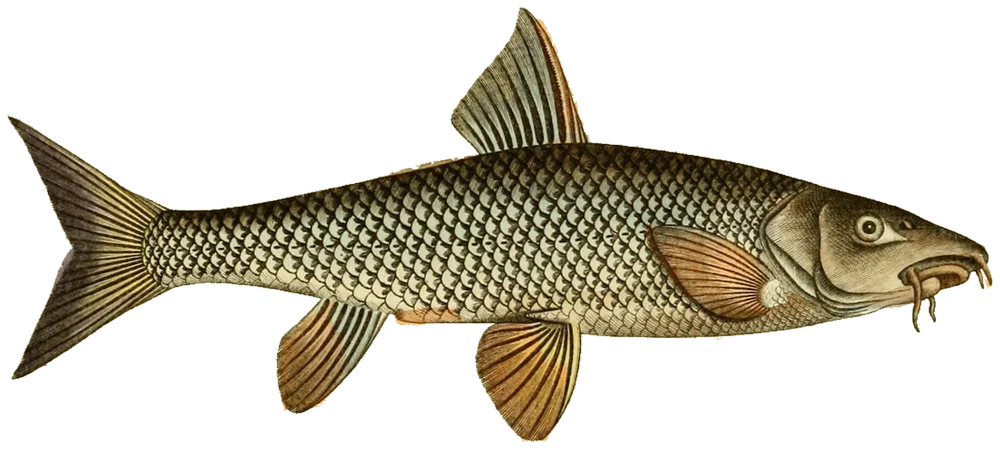
Barbel
Barbus barbus
The current is her home ground. You are only visiting.
How to recognise it. A long, cylindrical body, bronze-brown to olive. The mouth points downwards, with fleshy lips and four barbels in two pairs.
Where it lives. Fast stretches of medium and larger rivers with a gravel or stony bed. It, too, has a river zone named after it: the barbel zone.
What it eats. Bottom animals – insect larvae, worms, snails and small mussels – and occasionally algae and small fish.
When it is active. It lives in shoals on the bottom. By day it holds in the current behind obstacles; it goes foraging mainly at dusk and at night.
How it is caught. On the feeder or by ledgering. The weight has to hold the bait in place even in a strong current.
Worth knowing. Barbel roe is poisonous – do not eat it. And on the line it uses the current and its muscles so well that even a medium-sized fish will surprise you.
Conservation. Native species.
Length and weight
usually 35–60 cm · up to 120 cm
A rough estimate from the length–weight relationship (FishBase). A real fish can weigh noticeably more or less.
-
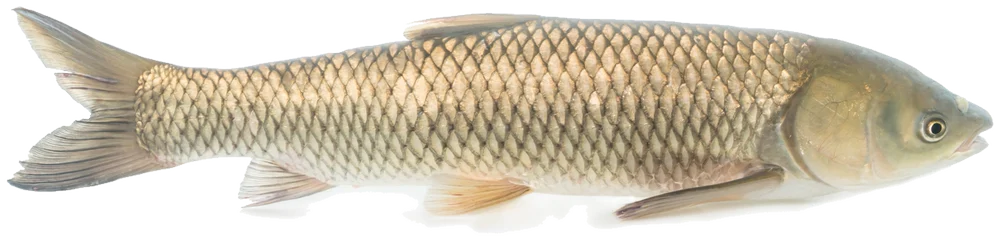
Grass carp
Ctenopharyngodon idella
A fish that takes its greens more seriously than most people do.
How to recognise it. A long, cylindrical body with large, regular scales and a broad head. It has no barbels and only a short dorsal fin – which makes it easy to tell from a carp.
Where it lives. It comes from East Asia – the Amur basin and the rivers of China. It has been stocked into Europe’s warmer ponds, reservoirs and slow rivers since the 1960s.
What it eats. Adults graze on water plants as well as grass and reeds along the bank. Young fish start on plankton and small animals.
When it is active. Its appetite rises with the temperature: it feeds flat out only in warm summer water and almost stops in the cold.
How it is caught. By ledgering, on the feeder and on the float with plant baits such as sweetcorn.
Worth knowing. It is stocked to keep water plants in check, but too many grass carp can graze a water bare and change it for everything else that lives there. Its eggs have to drift in the current of a long, warm river, so it hardly ever breeds in the wild here.
Conservation. Non-native species (East Asia); numbers depend on stocking.
Length and weight
usually 50–90 cm · up to 150 cm
A rough estimate from the length–weight relationship (FishBase). A real fish can weigh noticeably more or less.
-
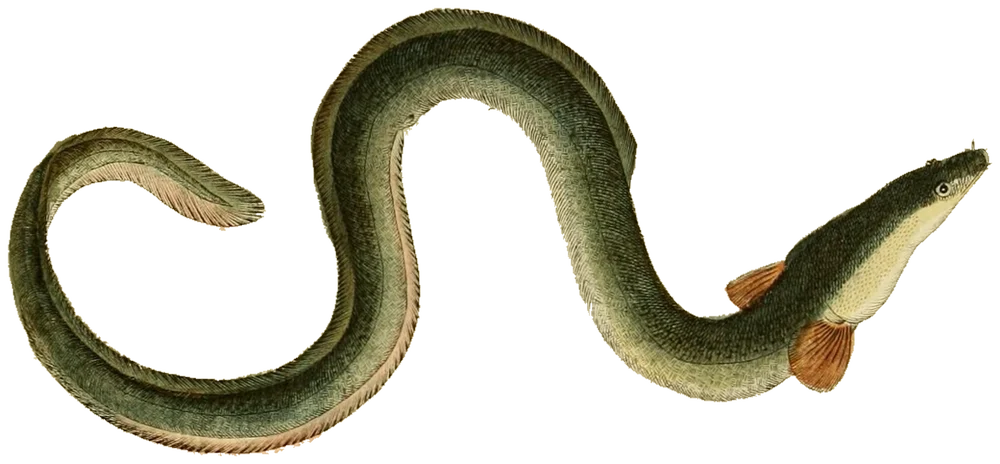
European eel
Anguilla anguilla
It can find its way across the Atlantic. Some people get lost on the way to their own cottage.
How to recognise it. A long, snake-like body and smooth, slimy skin with tiny scales embedded in it. The dorsal, tail and anal fins merge into one continuous fringe; there are no pelvic fins.
Where it lives. It spends most of its life in fresh or brackish water – rivers, lakes and reservoirs. By day it hides among stones and roots or in the mud.
What it eats. Insect larvae, worms, crustaceans and molluscs; larger eels also hunt fish.
When it is active. A creature of the night: it comes out to feed after dark, guided mainly by an excellent sense of smell.
How it is caught. Once a classic night-ledgering fish. Today it is critically endangered, so this atlas does not list it as a target species.
Worth knowing. It spawns in the Sargasso Sea, thousands of kilometres from Europe’s rivers. The ocean carries the larvae to Europe; years later the adults swim back and die after spawning. Nobody has ever watched eels spawn in the wild.
Conservation. Critically Endangered (IUCN). It is threatened by overfishing, dams and turbines on its migration routes, parasites and changes in the ocean. In the Danube basin it occurs mainly thanks to stocking.
Length and weight
usually 40–80 cm · up to 133 cm
A rough estimate from the length–weight relationship (FishBase). A real fish can weigh noticeably more or less.
-
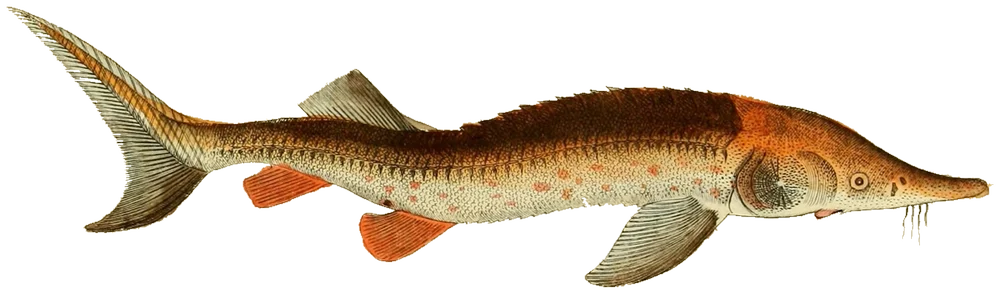
Sterlet
Acipenser ruthenus
It looks as if it has come straight from prehistory. And, to be fair, it has a pretty good claim to that look.
How to recognise it. A long body with five lengthwise rows of bony plates, a long narrow snout and an asymmetrical, shark-like tail. The mouth is on the underside of the head, with four fringed barbels hanging in front of it.
Where it lives. A purely freshwater sturgeon. It lives on the bottom in the deeper, flowing stretches of large rivers – in Slovakia, the Danube and the lower reaches of its tributaries.
What it eats. Bottom animals: insect larvae, worms, small crustaceans and molluscs, which it feels out with its barbels and sucks up with its extendable mouth.
When it is active. It keeps to the bottom in the current. In spring it moves upstream to gravel spawning grounds; it spends the winter in deep holes.
How it is caught. It is rare in the wild and not a target species. Sturgeon in private sport fisheries come from fish farms – often other species or their hybrids.
Worth knowing. Sturgeons are an ancient group of fish with a largely cartilaginous skeleton; their ancestors swam in rivers in the time of the dinosaurs. The sterlet is the smallest of the Danube sturgeons and the last one still living in Slovakia. Other species – the beluga, the Russian sturgeon and the stellate sturgeon – once migrated here from the Black Sea, until dams blocked the way.
Conservation. Endangered (IUCN). Native to the Danube basin; declining because of dams, river engineering and past overfishing.
Length and weight
usually 35–60 cm · up to 125 cm
A rough estimate from the length–weight relationship (FishBase). A real fish can weigh noticeably more or less.
Fish quiz
What Was That on My Line?
Ten questions about real identifying features: barbels, fins, mouths, body shape. Pick the fish that fits.
 Quietly Mad?Quietly Mad? Welcome to the World of Anglers
 Step 1Your First Trip: From First Rod to First Bite
 Ten waters on one mapWhere to Fish: From the Local Pond to the Big Trips
 Sea fishingWhen the Village Pond is No Longer Enough