
Magazine · Fishing · fish care
Catch and Release: Respect for the Fish Starts Before the Bite
Hours of preparation, a few minutes of playing the fish, one photo – and off it swims. From the far bank it looks like an odd way to end a trip. For many anglers it is the best one.
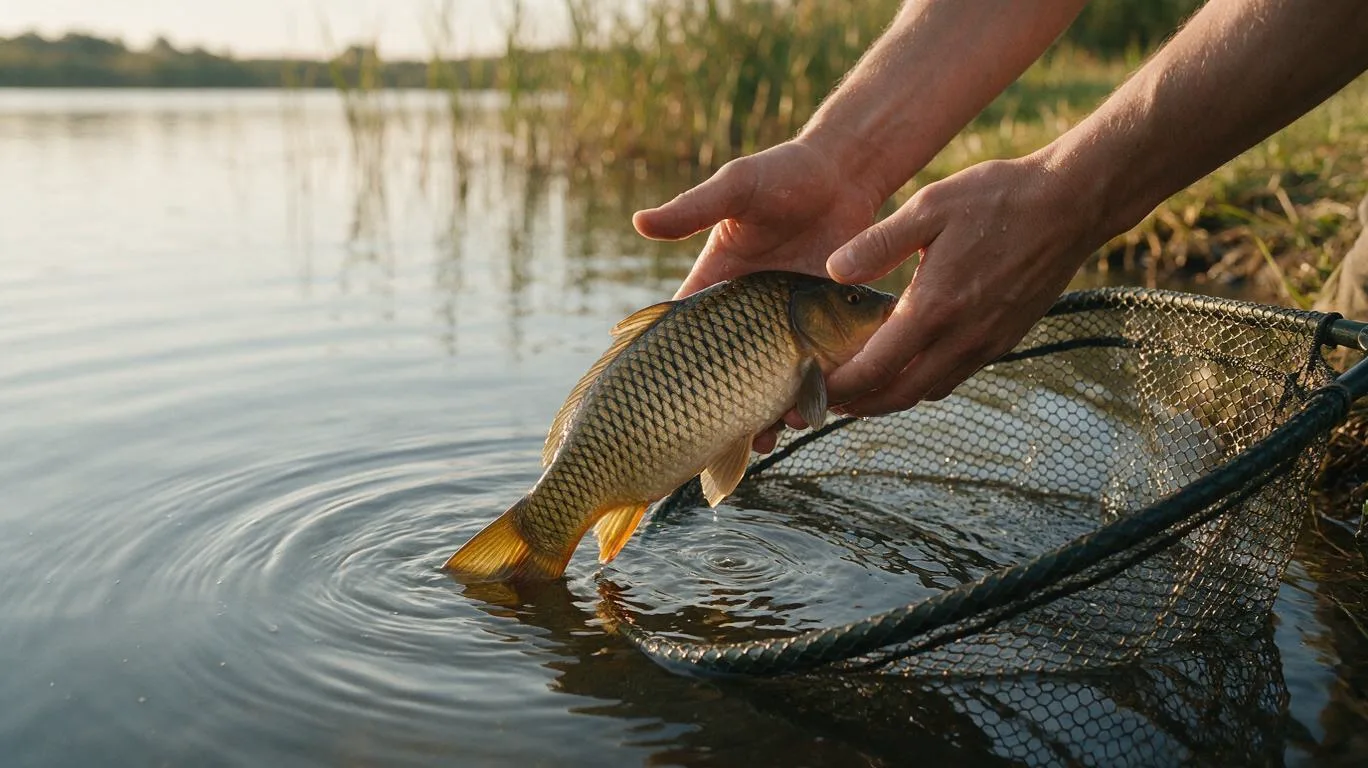
Letting a fish go, though, is more than opening your hands. Whether it survives depends mostly on you. And it starts long before the landing net.
Why let a fish go
There are several reasons. Sometimes you must, because the rules of your water say so. Sometimes you want a big fish to stay in the fishery for others to enjoy. And some people simply do not eat fish, yet love finding and outwitting them.
Science takes a sober view. A wide-ranging 2007 review led by Robert Arlinghaus describes catch and release as a practice shaped by biology, ethics and local custom alike. There is no single right answer for every water.
Care begins with the fight
Play the fish for as short a time as your tackle allows. A fighting fish is running up a debt, and the longer the fight, the longer the recovery. Tackle far too light for a big fish is therefore no sporting feat, just needless strain.
In 2005 the biologists Steven Cooke and Cory Suski summed up five general principles that help almost any species: a short fight, as little air exposure as possible, no fishing at extreme water temperatures, barbless hooks with artificial lures, and leaving fish alone at spawning time. They add that every species responds a little differently.
Net, mat and wet hands
A fish does not belong on grass, gravel or the bottom of a boat. Lift it with a landing net of soft knotless or rubberised mesh. If it has to leave the water, lay it on a wetted unhooking mat.
Always wet your hands. The slime on the skin protects a fish from infection, and a dry palm or a towel wipes it off. Do not squeeze the fish or put your fingers under its gills. Hold a larger one horizontally with both hands, low over the mat or the water.
Ten seconds is a long time
A fish cannot breathe in air. Keep Fish Wet, an organisation that turns research into advice for anglers, warns that as little as 10 to 20 seconds can harm some species. A simple trick: hold your breath when you lift the fish. When you need air, so does it.
Ideally, unhook the fish in the water, in the net. Keep forceps or a disgorger within reach, not at the bottom of your bag. If the hook is deep in the gullet, do not dig for it. Cut the line as close to the mouth as you can; the fish stands a better chance that way.
Get the camera ready before you lift the fish. When releasing it, support it upright in the water and wait until it swims off under its own power. Throwing it back from the bank is a bad idea.
When the risk is higher
Warm water holds less oxygen, and a fish in it burns more energy. Salmonids cope worst. In a study on rivers in Montana, no released trout died while the water stayed below 20 °C. In warmer water, 9 to 16 per cent of rainbow trout did. In a heatwave, then, leave trout and grayling in peace.
Zander are sensitive, too. After an experiment with varying times in air, German researchers advise not lifting a zander out of the water at all if it is to be released. Perch-family fish also suffer when hauled up quickly from deep water, because they cannot adjust the pressure in their swim bladder fast enough.
Released does not mean saved
Now for honesty. A review of 274 estimates from scientific studies found that, on average, about a fifth of released fish died; the median was 11 per cent and the range ran from zero to 95. Where the hook lodged mattered most. That enormous spread is actually good news: most of it lies in your own hands.
One more thing. A fish that is bleeding heavily or cannot recover gains nothing from being released. If the rules of your water allow it, the more honest choice is to keep it. Taking a fish home for supper within the rules is just as legitimate as letting it go.
Catch and release is not a badge that makes you a better angler. It is a craft like any other on the bank: it can be done well or badly. Done well, the only thing the fish takes away from your meeting is a bad mood.