
Magazine · Arabian perfumes · design
When a Scent Becomes a Work of Art
We choose a perfume with our nose, yet the first encounter belongs to the eyes. Before we ever press the atomiser, we take in the shape of the bottle, the colour of the glass and the way it catches the light.
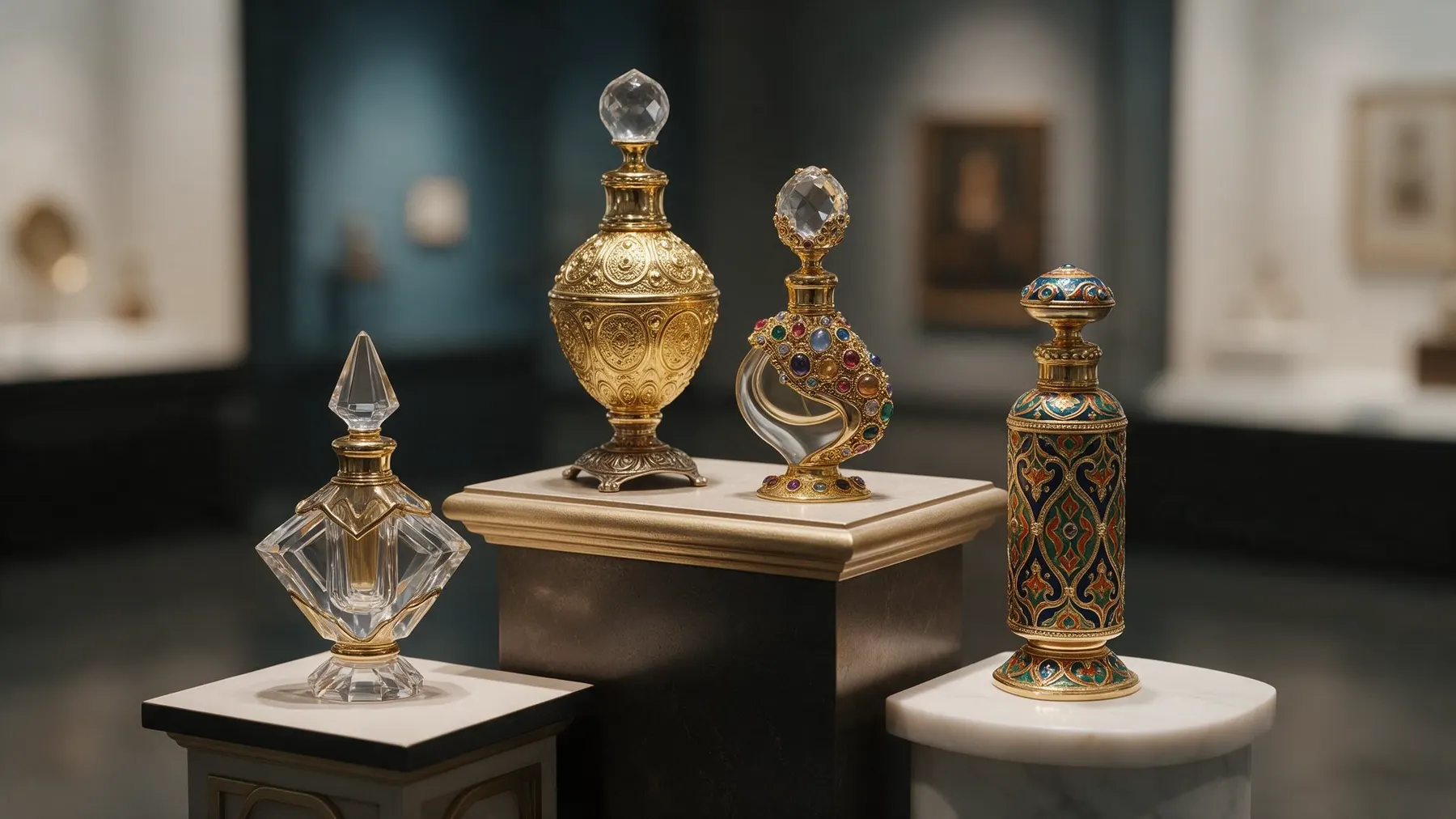
The perfume houses of the Arabian Peninsula know this very well. Their bottles resemble a jewel one moment and a small building the next – and many have a story as interesting as the scent inside.
Two ideas of beauty
A bottle is more than a vessel that shields perfume from light and air. It is the perfume’s face. On the shelves of Arabian perfume shops, two quite different worlds stand side by side: gilded caps, coloured glass and rich ornament on one hand, strict geometry and clean lines on the other.
This is not merely a matter of taste. For some, value should be visible – the more craftsmanship on show, the better. For others it lies in proportion, good materials and precise detail. Today’s brands from Oman and the Emirates work with both ideas, often within a single collection.
One word of caution: not every golden flourish continues an ancient tradition. Decorated vessels for scented oils do have a long history in many cultures, but most contemporary bottles are simply modern design, borrowing inspiration wherever it suits.
Glass, metal and one unsung hero
Glass can be clear, tinted, cut or frosted. Its look depends on colour but also on the thickness of the walls – a heavy base and thick glass feel quite different in the hand from a slender phial. Metal details, enamel or coloured stones then turn a simple shape into an ornament.
Often, though, it is the cap that does most of the work. On some bottles it is almost invisible; on others it makes up half the object and recalls a dome, a jewel or a small sculpture. The designer has physics to reckon with, too: a cap that is too heavy topples the bottle, and an elaborate surface is awkward to hold. A beautiful bottle must, above all, work.
Amouage: Oman in glass
The house of Amouage was founded in Muscat in 1983 by Sayyid Hamad bin Hamoud Al Busaidi, at the wish of Sultan Qaboos. The bottles still carry a reference to their country of origin.
The cap of the classic men’s bottles resembles the hilt of a khanjar – the curved dagger that is Oman’s national symbol and appears on its coat of arms. The women’s cap takes the shape of a mosque dome. Two small pieces of metal thus say where the perfume comes from without a single word on the label.
In 2022 the brand relaunched its Library Collection. The khanjar-inspired bottle was given a ceramic-like finish in muted, earthy shades. It is good proof that a national symbol can be carried into contemporary design without the result looking like a souvenir.
Swiss Arabian: two worlds in one name
Swiss Arabian chose a different path. The brand was founded in the United Arab Emirates in 1974 by Hussein Adam Ali and describes itself as the country’s first perfume house. Its programme is right there in the name: Arabian fragrance materials and Swiss technique.
You can see it on the shelves. Next to richly decorated phials for perfume oils stand sleek, colourful bottles you could easily place among European brands. A single idea of what an ‘Arabian perfume’ should look like simply does not hold here – and that is the most interesting part.
When packaging becomes a collector’s piece
Some bottles are designed to outlive their contents. Collectors are drawn to unusual shapes, limited editions and honest craftsmanship. Showiness alone, however, is not art – and certainly no guarantee that a bottle will one day be worth anything.
The question of sustainability is growing louder as well. Heavy glass, layered boxes and glued-on decoration mean more material and harder recycling, so brands are trying refillable bottles and simpler packaging. The future may belong not to more gold, but to a bottle that keeps serving for years.
We buy perfume for the scent. And yet there are bottles we keep long after the last drop – they remind us of the place where we found them, or of the person who gave them to us.
A bottle can be a beautiful object. But only the scent, and the story we attach to it, give it personal meaning.