
Magazine
From :-) to Emoji
You Have a New Message · emoji
Written text has no tone of voice. You can’t hear whether the writer is smiling or angry. The problem is as old as writing itself; the internet just made it urgent.
People solve it with a colon, a hyphen and a parenthesis. And later with hundreds of little pictures.
A Joke Taken Seriously
On 19 September 1982 at 11:44 a.m., Scott Fahlman proposed on Carnegie Mellon University’s electronic bulletin board that jokes be marked with :-) and things that are not jokes with :-(. The day before, people there had earnestly discussed a joking “warning” about mercury in an elevator. Someone suggested an asterisk, someone else a percent sign. What caught on was a smile lying on its side.
The original post was later lost. University technicians tracked it down only in 2001 and 2002, on old backup tapes.
Faces Made of Punctuation
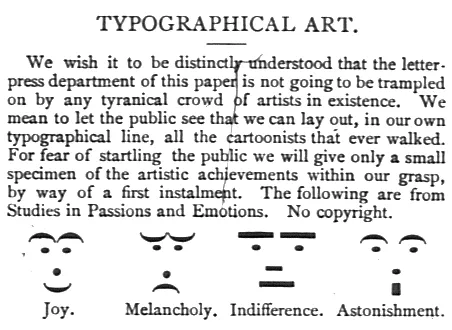
Fahlman wasn’t the first to build a face out of characters. In March 1881, the American satirical magazine Puck printed “Typographical Art”: faces made of punctuation for joy, melancholy, indifference and astonishment. In 1887 the writer Ambrose Bierce proposed a special mark for a chuckle, and in 1969 Vladimir Nabokov sighed that he could use a typographical sign for a smile.
Fahlman himself admits that he has heard of earlier users of :-). His achievement is a different one: he gave the smile a rule, and the rule spread.
Emoji Are Not Emoticons
An emoticon is assembled from characters, like :-). An emoji is a standalone picture character. The word comes from Japanese: e means picture and moji means character. Its link to the English “emotion” is pure coincidence.
The first sets were created in Japan for mobile phones. In 1997 the operator SoftBank released a phone with 90 emoji. The more famous set of 176 characters was designed in 1999 by Shigetaka Kurita’s team for NTT DOCOMO, and in 2016 New York’s Museum of Modern Art added it to its collection. Emoji spread worldwide once the Unicode standard adopted them in 2010.
Same Character, Different Picture
Every platform draws emoji its own way. The same character looks different on an iPhone, on Android and on a computer. In 2016, researchers from the GroupLens group found that for nine of the 22 emoji they studied, people disagreed, depending on the platform, about whether the face looked happy or sad.
More interesting still, they didn’t agree even when they were looking at exactly the same image. So a little face clears up less than we think.
A Word of the Year Without Letters
In 2015, Oxford Dictionaries named 😂, the face with tears of joy, its word of the year. According to Emojipedia, it was the most used emoji of the entire decade. And a picture now even carries legal weight: in 2023 a Canadian court accepted 👍 as agreement to a contract for a delivery of flax. The court of appeal upheld the decision a year later.
The smiley was invented so that people wouldn’t take a joke seriously. Forty years later, we take a thumbs-up seriously. Writing has changed more than Fahlman could have expected on his bulletin board.